How do
creatures get their orientation right? Does it have anything to do with
Alzheimer's? Nobel-Prize Laureates May-Britt and Edvard Moser have found some
answers to those questions.
Deutsche Welle, 6 Oct 2014

"We
are interested in how space is mapped in the brain. In doing so, we used rats
and their appetite for chocolate." That is how May-Britt and Edvard Moser
described their work in an interview with Deutsche Welle. Chocolate is a reward
for the rats and they always receive their treats at the end of specific tests.
Rats are
important for the research of the two Norwegians - they have to find their way
around in a specified, confined space, while the researchers look at their
brain activity.
Grid cells
give orientation
In 2005,
the couple found special brain cells, so called "grid cells". Those
cells form an imaginary hexagonal coordinate system - a grid - in the brain.
The grid looks similar to tiles in a bathroom, Edvard Moser explains: "It
is thought that these are part of an internal map that is based on our own
movement, so that these cells signal the distances we move and the directions
we take".
To measure
this, the Mosers used tiny electrodes, located between the nerve cells of the
rats' brain. "Then we picked up the electric signals of the cells,"
Moser says.
 |
| May-Britt and Edvard Moser work in the Norwegian town of Trondheim |
Practically
speaking, it means the rat received an implant in the brain, with cables coming
out of its head that were linked to a computer. That way, the researchers were
able to receive and measure impulses coming out of the rat's brain. They were
also able to see what happens in the brain, when the rat concluded certain
tasks.
The
imaginary map is stored within thousands of cells inside the brain of the rat.
Whenever the animal returned to a place it had been before, the map was reactivated,
thereby enabling orientation.
Rats and
mice are very well suited for such experiments, Moser says. "They depend
on finding their way in nature, so their navigational skills and their mapping
skills are very well developed, and for that reason, we can learn a lot from
studying them. "
Cooperation
among many cells
Apart from
these "grid cells" other cells are essential for orientation - for
example so-called "border cells", which the Norwegian researchers
have also found. These cells become active, when the rat approaches an
obstacle, like a wall for example.
The
"border cells", however, do enter into communication with so called
"directional cells." Those serve as a compass and send out signals
whenever the mouse turns its head in a specific direction. All those cells are
building blocks for so called "place cells" - the general orientation
cells that John O' Keethe, who shares the 2014 Nobel Prize for Medicine with
the Mosers, had already discovered in 1971.
These are
located in the hippocampus, the part of the brain, which is essential for
remembering things. And there are probably many more cells to be discovered:
"There is probably yet another one that tells us about the speed we are
moving in space, So, I don't think we have seen the end yet. There are many,
many functionally specialized types of cells", Moser believes.'
 |
| Being disorientated can be an early symptom of Alzheimer's disease |
New
approaches to understanding Alzheimer's?
The
findings of the Moser couple enable the measuring of brain-activity. Recent
research has also shown that humans have similar grid cells. The research could
potentially help research into Alzheimer's, as the disease tends to start with
patients feeling utterly disorientated.
What is
knwon is that the area of the brain the Mosers researched, is identical with
the area of the brain that is affected in Alzheimer's patients. "So, quite
often, if you scan brains with Alzheimer's disease you can see that there are
changes in the brain area which take place before the patient has got any
diagnosis."
It stands
to reason to assume that this has something to do with the fact that most
Alzheimer's patients lose their sense of direction first. "We are trying
to understand the principles of how the brain is working, and when that is
known we will probably not only be able to deal with Alzheimer's disease but a
wide range of neurological and psychiatric diseases because when we know how
the brain works on a more general sense then we can also treat all of these
conditions."
Researchers
with a passion
The
51-year-old May-Britt and 52-year-old Edvard Moser have been researching brain
activity ever since their studies at the university of Oslo. They have been working
with their research teams in Trondheim since 1996, where they founded the
"Center for the Biology of Memory" in 2002. In 2007, it merged into
the Kavli-Institute for Systems Neuroscience.
In both
institutes, research focuses on the brain of animals and humans. "It is
like looking into ourselves. It is scary and fascinating at the same time. For
me personally, it is more fascinating. You never stop being amazed how clever
this system is."
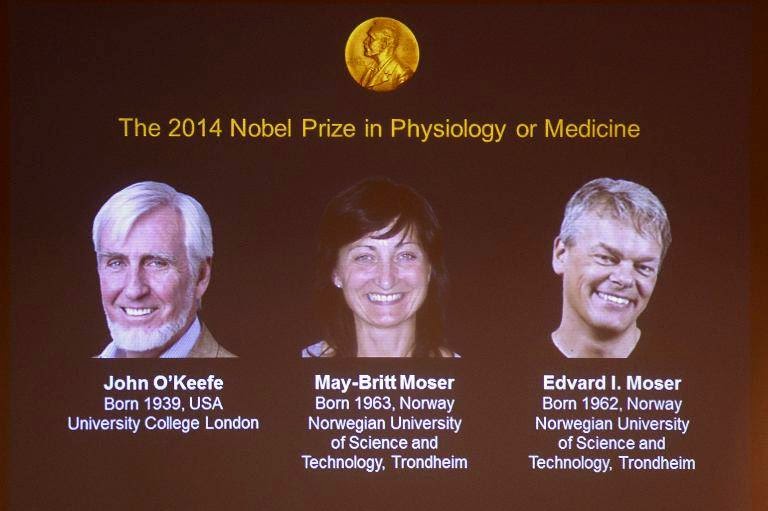 |
A giant
screen displays the images of (L-R) John O'Keefe, May-Britt Moser and Edvard
Moser at the naming of the Nobel Medicine
Prize winners, on October 6, 2014 in
Stockholm
(AFP Photo/Jonathan Nackstrand)
|
Related Articles:
Question: Dearest Kryon: I've read the question and answer on people with diseases of the mind - for example, Alzheimers and dementia. But I have more questions. You say that people have chosen this path and that the lessons are for us. As I work with these people, I'm wondering if there is any stage where there could be a reversal of the condition, and if so, with what methods? The people in the hostel are so drugged up, and there's a mind-set with the authorities that no "alternate" therapies work - although they're using colored lights. (Sadly, the diversional therapist told me she doesn't know what color therapy is.)
From a spiritual point of view, what is the best way to work with these people - talk to them as though they were normal, or go along with their imaginings? I've been told that they need to be kept quiet, especially toward evening. However, I've found that with one woman who mostly paces saying very little, the more childlike I am (dancing and singing makes her happy), the more she talks. I could go on and on - could you please enlighten me further?
Answer: I will answer the second part first. Love those who are in this condition. Find out what makes them smile... and then make them smile. The best you can do in a facilitation of this condition is to somehow create joy. Even in their confusion they can laugh at situations and be creative. They'll also remember you better as the one who creates this emotion. Each is very different, but in general, try to find their "happy" button and push it as often as you can. They will remember that.
Right now you're perched upon some important discoveries that will be able to reverse these conditions to a large degree. But just as the paraplegic who regains their nerve connections must than relearn how to walk, suffering much pain, there will be this attribute with a regeneration of the mind. Even if new cells are created, they won't necessarily have the old memories, but they can be trained to be healthy and be ready for new memories.
So someday these will have the ability to halt the progress of the degeneration of cells that are being taken, and instead grow new pathways around them. Some will be able to "reconnect" to certain kinds of memories (like recognition) but will have to relearn what the association of recognition actually means. So history and events might have to be studied and relearned... sometimes even things like reading, also. The pain will be that the individual will regain mental health and will realize exactly what has happened.
Your stem-cell research is very important, and you're reaching a point where you'll be able to use birth cells that aren't embryonic, but every bit as potent for research... thereby sidestepping all moral issues. Look for this in the next few years.
No comments:
Post a Comment
Note: Only a member of this blog may post a comment.