(Subjects: Religion/Worship, Lightworkers, Food, Health, Prescription Drugs, Homeopathy, Innate (Body intelligence), New Age movement, Global Unity, ... etc.) - (Text version)

“…… Should I use Doctors and Drugs to Heal Me or Spiritual Methods?

"Dear Kryon, I have heard that you should stay natural and not use the science on the planet for healing. It does not honor God to go to a doctor. After all, don't you say that we can heal with our minds? So why should we ever go to a doctor if we can do it ourselves? Not only that, my doctor isn't enlightened, so he has no idea about my innate or my spiritual body needs. What should I do?"

First, Human Being, why do you wish to put so many things in boxes? You continue to want a yes and no answer for complex situations due to your 3D, linear outlook on almost everything. Learn to think out of the 3D box! Look at the heading of this section [above]. It asks which one should you do. It already assumes you can't do both because they seem dichotomous.

Let's use some spiritual logic: Here is a hypothetical answer, "Don't go to a doctor, for you can heal everything with your mind." So now I will ask: How many of you can do that in this room right now? How many readers can do that with efficiency right now? All of you are old souls, but are you really ready to do that? Do you know how? Do you have really good results with it? Can you rid disease and chemical imbalance with your mind right now?

I'm going to give you a truth, whether you choose to see it or not. You're not ready for that! You are not yet prepared to take on the task of full healing using your spiritual tools. Lemurians could do that, because Pleiadians taught them how! It's one of the promises of God, that there'll come a day when your DNA works that efficiently and you will be able to walk away from drug chemistry and the medical industry forever, for you'll have the creator's energy working at 100 percent, something you saw within the great masters who walked the earth.

This will be possible within the ascended earth that you are looking forward to, dear one. Have you seen the news lately? Look out the window. Is that where you are now? We are telling you that the energy is going in that direction, but you are not there yet.

Let those who feel that they can heal themselves begin the process of learning how. Many will be appreciative of the fact that you have some of the gifts for this now. Let the process begin, but don't think for a moment that you have arrived at a place where every health issue can be healed with your own power. You are students of a grand process that eventually will be yours if you wish to begin the quantum process of talking to your cells. Some will be good at this, and some will just be planting the seeds of it.

Now, I would like to tell you how Spirit works and the potentials of what's going to happen in the next few years. We're going to give the doctors of the planet new inventions and new science. These will be major discoveries about the Human body and of the quantum attributes therein.

Look at what has already happened, for some of this science has already been given to you and you are actually using it. Imagine a science that would allow the heart to be transplanted because the one you have is failing. Of course! It's an operation done many times a month on this planet. That information came from the creator, did you realize that? It didn't drop off the shelf of some dark energy library to be used in evil ways.

So, if you need a new heart, Lightworker, should you go to the doctor or create one with your mind? Until you feel comfortable that you can replace your heart with a new one by yourself, then you might consider using the God-given information that is in the hands of the surgeon. For it will save your life, and create a situation where you stay and continue to send your light to the earth! Do you see what we're saying?

You can also alter that which is medicine [drugs] and begin a process that is spectacular in its design, but not very 3D. I challenge you to begin to use what I would call the homeopathic principle with major drugs. If some of you are taking major drugs in order to alter your chemistry so that you can live better and longer, you might feel you have no choice. "Well, this is keeping me alive," you might say. "I don't yet have the ability to do this with my consciousness, so I take the drugs."

In this new energy, there is something else that you can try if you are in this category. Do the following with safety, intelligence, common sense and logic. Here is the challenge: The principle of homeopathy is that an almost invisible tincture of a substance is ingested and is seen by your innate. Innate "sees" what you are trying to do and then adjusts the body's chemistry in response. Therefore, you might say that you are sending the body a "signal for balance." The actual tincture is not large enough to affect anything chemically - yet it works!

The body [innate] sees what you're trying to do and then cooperates. In a sense, you might say the body is healing itself because you were able to give it instructions through the homeopathic substance of what to do. So, why not do it with a major drug? Start reducing the dosage and start talking to your cells, and see what happens. If you're not successful, then stop the reduction. However, to your own amazement, you may often be successful over time.

You might be able to take the dosage that you're used to and cut it to at least a quarter of what it was. It is the homeopathy principle and it allows you to keep the purpose of the drug, but reduce it to a fraction of a common 3D dosage. You're still taking it internally, but now it's also signaling in addition to working chemically. The signal is sent, the body cooperates, and you reduce the chance of side effects.

You can't put things in boxes of yes or no when it comes to the grand system of Spirit. You can instead use spiritual logic and see the things that God has given you on the planet within the inventions and processes. Have an operation, save your life, and stand and say, "Thank you, God, for this and for my being born where these things are possible." It's a complicated subject, is it not? Each of you is so different! You'll know what to do, dear one. Never stress over that decision, because your innate will tell you what is appropriate for you if you're willing to listen. ….”

Monsanto / GMO - Global Health


(Subjects: Big pharma [the drug companies of America] are going to have to change very soon or collapse. When you have an industry that keeps people sick for money, it cannot survive in the new consciousness., Global Unity, ... etc.) - (Text version)
"Recalibration of Free Choice"– Mar 3, 2012 (Kryon Channelling by Lee Caroll) - (Subjects: (Old) Souls, Midpoint on 21-12-2012, Shift of Human Consciousness, Black & White vs. Color, 1 - Spirituality (Religions) shifting, Lose a Pope “soon”, 2 - Humans will change react to drama, 3 - Civilizations/Population on Earth, 4 - Alternate energy sources (Geothermal, Tidal (Pedal wheels), Wind), 5 – Financials Institutes/concepts will change (Integrity – Ethical) , 6 - News/Media/TV to change, 7 – Big Pharmaceutical company will collapse “soon”, (Keep people sick), (Integrity – Ethical) 8 – Wars will be over on Earth, Global Unity, … etc.) - (Text version)
"The Recalibration of Awareness – Apr 20/21, 2012 (Kryon channeled by Lee Carroll) (Subjects: Old Energy, Recalibration Lectures, God / Creator, Religions/Spiritual systems (Catholic Church, Priests/Nun’s, Worship, John Paul Pope, Women in the Church otherwise church will go, Current Pope won’t do it), Middle East, Jews, Governments will change (Internet, Media, Democracies, Dictators, North Korea, Nations voted at once), Integrity (Businesses, Tobacco Companies, Bankers/ Financial Institutes, Pharmaceutical company to collapse), Illuminati (Started in Greece, Shipping, Financial markets, Stock markets, Pharmaceutical money (fund to build Africa, to develop)), Shift of Human Consciousness, (Old) Souls, Women, Masters to/already come back, Global Unity.... etc.) - (Text version)
"THE BRIDGE OF SWORDS" – Sep 29, 2012 (Kryon channeled by Lee Carroll) (Subjects: ... I'm in Canada and I know it, but I will tell those listening and reading in the American audience the following: Get ready! Because there are some institutions that are yet to fall, ones that don't have integrity and that could never be helped with a bail out. Again, we tell you the biggest one is big pharma, and we told you that before. It's inevitable. If not now, then in a decade. It's inevitable and they will fight to stay alive and they will not be crossing the bridge. For on the other side of the bridge is a new way, not just for medicine but for care. ....) - (Text Version)

Pharmaceutical Fraud / Corruption cases

Health Care

Health Care
Happy birthday to Percy Julian, a pioneer in plant-drug synthesis. His research produced steroids like cortisone. (11 April 2014)
Showing posts with label Medical-Service-Equipment. Show all posts

Friday, October 16, 2020

Fast Covid test development speeds up, latest gives result in less than a minute

DutchNews, October 15, 2020 

Photo: Brandon Hartley

A Dutch company has developed a breathalyser test which will almost instantly exclude people who do not carry the coronavirus and which could significantly ease the pressure on testing facilities. 

The device, which is made by Breathomix in Leiden and can detect particles in people’s breath, was tested on 1,800 people in an Amsterdam testing facility. They then had the more time consuming PCR test.

Investigations showed that some 1,350 people could have been sent home immediately had they taken only the breathalyser test. The device was able to exclude coronavirus in three quarters of the participants but was inconclusive in the remaining quarter. 

Despite this it is thought that a large scale application of the test, which takes approximately 45 seconds, including the result, could ease the pressure on testing facilities, some of which are reaching crisis point. 

The health ministry has ordered hundreds of the breathalysers which, on final approval, will be used by testing facilities by the end of next month, health minister Hugo de Jonge said on Thursday. 

TNO 

Meanwhile Dutch research institute TNO announced it has developed a fast test which it claims is as reliable as the PCR  process currently used in nationwide testing centres. 

It too was validated at a facility in the capital and showed a 99% accuracy rate compared to the PCR test when used on 900 people. 

TNO developed a so-called LAMP-test which works at a molecular level and gives a result in 45 minutes to an hour. 

Last week, two fast tests produced by American companies BD and Abbot were approved by the health ministry. Each of these take 15 minutes to come up with a result,and will be used in addition to the normal health board tests.

Wednesday, January 29, 2020

Philips to spin off domestic appliance unit, focus on healthcare technology

DutchNews, January 28, 2020 

Philips at a radiology trade fair in December. Photo: Philips

Dutch electronics giant Philips is to spin off its domestic appliance division to focus purely on health technology and personal care items. 

The company has started creating a separate legal structure for its domestic appliances division, which booked sales of €2.3bn last year, and expects this process to be completed within a year to 18 months. 

The unit, which includes air fryers and coffee makers, has made ‘a very important contribution to Philips’ chief executive Frans van Houten said in a statement. 

‘However this business is not a strategic fit for our future as a health technology leader,’ he said. ‘We are committed to finding a good home for this business to continue to thrive and grow over time, as we expand and invest in our consumer health and professional healthcare related businesses.’ 

Philips made the announcement at the publication of its 2019 figures. The company saw like-for-like full year sales rise 4.4%% to €19.5bn. Income from continuing operations was down slightly at €1.2bn. 

Houten said ‘headwinds’ were to blame for the company’s failure to meet its profitability improvement target. 

In 2016, Philips spun off its lighting activities, which are now bourse-listed under the name Signify. The company’s roots date back 130 years to the light bulb business founded by Frederik and Gerard Philips in 1891 in Eindhoven.

Sunday, September 15, 2019

In Ivory Coast, telemedicine revolution proves blessing for heart patients

Yahoo – AFP, David ESNAULT, September 14, 2019

Thousands of heart patients in Ivory Coast are checked by telemedicine
each year (AFP Photo/DAVID ESNAULT)

Bouaké (Ivory Coast) (AFP) - Every time Catherine Coulibaly's 19-year-old son had to make a routine appointment with the cardiologist for his heart condition, she gritted her teeth as she silently counted the financial cost.

It wasn't just the hospital fee -- there was the transport, food and accommodation, too, all of it amounting to a hefty burden for an Ivorian family on a modest income.

But thanks to telemedicine -- consultations that doctors conduct through the internet or by phone -- this cost is now a fading memory.

Her son can book an appointment at a telemedicine facility in a nearby town in northern Ivory Coast.

There, he is attached to monitoring machines which send the data sent to Bouake University Hospital in the centre of the country, where it is scrutinised by a heart doctor.

The fledgling technology has long been championed by health advocates for poor rural economies.

Ivory Coast has become an African testbed for it, thanks to a project linking the Bouake hospital's cardiac department with health centres in several northern towns, some of which are a four-hour drive away.

Telemedicine "caused a sigh of relief for the population of Bouake, Boundiali, Korhogo, everyone," says Auguste Dosso, president of the "Little Heart" association, which helps families with cardiac health issues.

Some 45 percent of the Ivorian population live below the poverty line, according to the World Bank's latest estimate in 2017. And the minimum monthly wage -- not always respected -- is only around $100, or 90 euros.

Heart disease surging

The pioneer behind the scheme is cardiologist Florent Diby, who set up an association called Wake Up Africa.

In Ivory Coast, heart disease, diabetes and other "lifestyle" ailments are surging, Diby explained.

Cardiac specialists are rare in Ivory Coast -- patients can spend much of their
income in transport and accommodation when they need a consultation 
(AFP Photo/DAVID ESNAULT)

"Urbanisation is making people more sedentary, and there's the rise in tobacco consumption, changes in diet, stress," Diby said.

Three decades ago, only around one in eight of the Ivorian population had high blood pressure -- now the figure is one in four, on a par with parts of Western Europe.

But in Ivory Coast -- and across Africa -- well-equipped cardiology units are rare.

"Ninety percent of heart attacks can be diagnosed by telemedicine, so for us cardiologists it's a revolutionary technology," said Diby.

The beauty of the telemedicine scheme is that neither the doctor nor the patient has to travel far.

The cardiac patient is hooked up to the electrocardiogram (ECG) and other diagnostic machines with the help of a technician in a local health centre, which is connected to a computer in Bouake's University Hospital.

The cardiologist there can then see the results in real time, provide a diagnosis and prescribe treatment.

The five-year-old project has already linked 10 health centres to the seven cardiologists at Bouake, enabling 4,800 patients in other towns to receive consultations by telemedicine each year. The goal is to expand this to 20 sites, doubling the intake.

Expertise France, the French public agency for international technical assistance, subsidises up to 185,000 euros of the network, which pays for equipment such as computers, artificial intelligence software and internet connections.

Diby is now calling for telemedicine to be expanded in other medical fields such as neurology and psychiatry, not just in the Ivory Coast, but across West Africa too.

That opinion is shared by other experts. Sixty percent of Africans live in rural areas, where shortages of doctors are usually acute.

But numerous hurdles need to be overcome, especially investment in computers and access to the internet, according to a 2013 analysis published by the US National Library of Medicine.

Tuesday, January 8, 2019

Eli Lilly to acquire Loxo Oncology for $8 billion

Yahoo – AFP, January 7, 2019

An employee works in an unit dedicated to the production of insulin pens at the
factory run by pharmaceutical company Eli Lilly in Fegersheim, eastern France,
on October 12, 2015

Washington (AFP) - Pharmaceutical giant Eli Lilly will acquire cancer treatment specialist Loxo Oncology in a cash deal valued at around $8 billion, the companies said on Monday.

The firms "announced a definitive agreement for Lilly to acquire Loxo Oncology for $235.00 per share in cash, or approximately $8.0 billion," a statement said.

The deal -- which represents a premium of some 68 percent over Loxo Oncology's closing share price on Friday -- is expected to close by the end of the first quarter, the statement said.

The announcement is the latest in a series of major pharmaceutical deals: last week, Bristol-Myers Squibb said it would buy biotech firm Celgene in a $74 billion cash-and-stock agreement, creating a rival to the world's largest drug makers.

Other recent large pharma deals include French company Sanofi's purchase of US hemophilia group Bioverativ for $11.6 billion and Novartis' $8.7 billion acquisition of rare-disease treatment company AveXis.

Wednesday, March 7, 2018

Record number of international takeovers in Dutch healthcare sector

DutchNews, March 6, 2018


A record number of international takeovers were made in the Dutch healthcare sector last year, according to new research by consultancy Boer & Croon Corporate Finance (BCCF). 

The companies involved in the 32 international acquisitions recorded in 2017 were mainly service providers, such as suppliers of medical software, laboratory services and medical aids. 

‘We have known for some time that international companies are interested in the Dutch healthcare sector and that is now clearly reflected in the figures,’ says Dagma Enklaar, a partner with BCCF. 

The total number of acquisitions, both national and international, grew from 81 in 2016 to 90 last year. That is in line with the trend in recent years, when the number of deals has been rising year by year. 

However, there was a drop in the number of takeovers involving care homes and clinics – down from 43 in 2016 to 22 last year.

‘Takeovers in this sectors are a little more difficult because these companies are heavily regulated,’ Enklaar told the Financieele Dagblad. ‘Buyers are generally more circumspect if there is a lot of regulation and legislation, as has been the case here in recent years.’

Wednesday, June 17, 2015

Philips signs mega-deal with US hospital

DutchNews.nl, June 16, 2015

Dutch electronics giant Philips on Tuesday announced it has signed a deal worth $500m to supply medical equipment to a US hospital. 

The agreement with the Westchester Medical Center Health Network (WMCHealth), which covers a 15-year period, covers not only the medical equipment but also the accompanying services. 

Philips already has a number of these dual contracts in the Netherlands but this is one of the first to be signed in the US. 

WMCHealth serves three million people to the north west of New York City and is the regional provider of complex medical and surgical treatments. 

Philips and WMCHealth will work together on the provision of acute care, prevention and health care at a distance, known as telehealth.

Related Article:


Sunday, June 14, 2015

Doctor promoting DIY cervical cancer tests has shares in test-making firm

DutchNews.nl, June 13, 2015

A VU University professor who was the ‘driving force’ behind changes in the cervical cancer check-up system has financial interests in the company producing the new test, the NRC said on Saturday. 

Clinical pathologist Chris Meijer failed to declare that he has shares in Delphi Bioscience which makes the equipment women can use to take a sample for testing, the paper said. 

The government has decided that from 2016, women will be able to opt to take a sample themselves and then send to a laboratory for analysis. 

The switch to the new system is based on advice from the national health council dating from 2011. Meijer was an advisor to the council at the time and failed to declare his interest, the NRC said. Nor did he inform the then-health minister Ab Klink. 

Council chairman Pim van Gool told the paper Meijer’s actions are ‘absolutely wrong’ and failed to meet council guidelines. 

Congresses

Documents also show Meijer has promoted the diy test at congresses but failed to inform the VU, the NRC said. The VU has also decided to investigate a potential conflict of interest in Meijer’s academic publications, the Telegraaf reported. 

The health ministry has also issued a statement saying it has asked the health council to launch a thorough investigation. 

Meijer officially retired in 2010 but still has a part-time position at the teaching hospital.

Related Article:


Tuesday, May 19, 2015

Philips signs extensive echography contract with Delft hospital

DutchNews.nl, May 18, 2015

Dutch electronics giant Philips on Monday announced the signing of a 15-year agreement to supply echography technology to the Reinier de Graaf hospital in Delft.

It is the biggest-ever contract Philips has signed for medical equipment in the Netherlands, and gives the hospital much faster access to this diagnostic tool. The partnership with Philips is expected to help the hospital optimise its operating results in the long-term. 

The contract, an extension to an existing agreement, deals with the replacement and maintenance of all the echography systems in the hospital. The new generation of echography equipment will be used to investigate the stomach area, in pregnancy tests and in the treatment of rheumatism.

The Reinier de Graaf hospital employs around 3,000 staff. As well as its main location in Delft, it has hospitals in Voorburg, Naaldwijk and The Hague-Ypenburg. 

Philips, which started life as a manufacturer of light bulbs, is sharpening its focus to concentrate on healthcare technology. 

Echography is a radiologic technique in which deep structures of the body are visualised by recording the reflections (echoes) of ultrasonic waves directed into the tissues.

Wednesday, March 25, 2015

Giant rats helping to sniff out tuberculosis in Mozambique

Kitten-sized rats are being used by scientists to detect tuberculosis-causing bacteria in a project which hopes to save both time and money

The Guardian, AFP, Tuesday 24 March 2015

A giant rat used to detect tuberculosis-causing bacteria at Apopo research
 centre in Eduardo Mondlane University in Maputo, Mozambique. Photograph:
Adrien Barbier/AFP/Getty Images

Giant rats may strike fear and disgust into the hearts of homeowners worldwide, but researchers in Mozambique are improbably turning some of them into heroes.

At Eduardo Mondlane University in the capital Maputo, nine giant rats are busy at work – sniffing out tuberculosis-causing bacteria from rows of sputum samples.

These are no ordinary rats, as they have undergone six months of training in Tanzania. Their most distinguishing asset is their impeccable sense of smell.

Placed inside a glass cage, a rat darts from sample to sample, then stops or rubs its legs, indicating that a sample is infected with a TB causing bacteria.

Once the task is complete, it is given a treat through a syringe for a job well done.

“Within 30 minutes, the rat can test close to a hundred samples, which normally takes a laboratory technician four days,” said Emilio Valverde, TB program director at APOPO, the organisation leading the research.

The project, which started in February 2013, has brought hope to thousands of TB sufferers who sometimes receive false results and test negative using the standard laboratory system.

In 2006, tuberculosis was declared a national emergency in Mozambique, with 60,000 people in 2014 said to be infected, according to the ministry of health.

That number was a 10 percent increase from 2013.

Samples delivered to the university for testing are collected from 15 health centres across Maputo.

Belgian group APOPO is planning to expand the program to other parts of the country, while working on getting the system approved by the World Health Organization.

The organisation claims rat testing is more cost effective than other conventional methods.

Each rat costs around $6,700 to $8,000 to train, with a six-to-eight-year life span.

The cost is lower compared to rapid diagnostic test GeneXpert, which costs up to $17,000 per device, setting the state back between $10 and $17 per test.


They are light enough to cross terrain without triggering the mines, and are followed by de-mining experts who reward the rats with bananas.

The rats weigh up to 1.5 pounds and are said to be “easier to catch and train” – according to Valverde.

Samples pointed out by the rats to contain TB bacteria are then sent for further tests using fluorescence microscopy, a more sensitive laboratory technique.

The results are sent back to health centres, allowing patients to start treatment early.

Although TB is a treatable disease, in underdeveloped countries like Mozambique it can be deadly if left untreated and is particularly harmful to people living with HIV.

Mozambique is one of the countries worst affected by TB and 1 in 10 adults is HIV-positive.

With World Tuberculosis Day being marked on Tuesday, the Mozambican Ministry of Health said it was cautiously monitoring the APOPO work.

“This technique has to be compared to others that are available and already WHO approved, such as GeneXpert or LED microscope,” said Ivan Manhica, who heads the national programme for tuberculosis at the health ministry.

According to the WHO, TB killed 1.5 million people in 2013.


Wednesday, June 25, 2014

3D printing technology used in surgery

English.news.cn   2014-06-25


CHANGSHA, June 25 (Xinhua) -- A Chinese hospital has become the country's first to experiment with 3D printing technology in vascular surgery.

Huang Jianhua, director of surgery in Hunan Xiangya Hospital in central China's Hunan Province, said on Wednesday that 3D printing had been used in an operation to remove an aneurysm from a patient's abdomen. It was used to increase precision of the surgery.

He said the operation, which was completed earlier this month, involved a high level of risk because the tumor had swollen the patient's aorta from 2 cm in diameter to 6 cm.

The hospital contracted a 3D printing firm to make a 3D print of the CT scan of the patient's tumor and its surrounding blood vessels.

Surgeons used the printed model to set up intravascular tubes and remove the tumor.

3D printing is more popular in the manufacturing and construction sectors. Its application in the clinical medical field is still in an initial phase.

Editor: Xiang Bo
Related Articles:


The plastic skull was made with the help of a 3D printer: Photo: UMC Utrecht


Friday, June 20, 2014

China Focus: 3D printing industry begins to boom

English.news.cn, 2014-06-20


QINGDAO, June 20 (Xinhua) -- With products ranging from stem cells, shoes and mini-statues, 3D printing has started to boom in China amid the industry's rapid development worldwide.

Qingdao Unique Products Develop Co., Ltd announced that adipose-derived stem cells and corneal stromal cells exported via a biological 3D printer had survived for nine days.

Cell-printed tissues can be used for organ transplants or restoration, said Wang Hong, board chairman of the company at the 2014 World 3D Printing Technology Industry Exhibition, which opened on Thursday in east China's coastal city of Qingdao.

The four-day event has attracted 110 3D printing companies at home and from abroad and will showcase latest 3D printing equipment, technology and products.

"Except for the laces, the sports shoe was directly printed out," said Zhang Xuan, general manager of Qingdao AOD 3D Printing Co., Ltd, a high-tech manufacturer of 3D printers.

The cost of materials for the shoe is only 40 yuan (6.5 U.S. dollars), Zhang told Xinhua at the exhibition hall, where products such as printed sports shoes, shavers and bicycles are on display.

"3D printing will be a new growth area of our company. Many products can be realized through 3D printing and it will bring considerable profits," said Peng Jun, manager of the printing department of Golden Laser Co., Ltd in Wuhan, capital of central China's Hubei Province.

The global 3D printing industry's output was about 12 billion yuan in 2012 and 20 billion yuan last year, according to China 3D Printing Technology Industry Alliance data.

China's 3D printing output was 1 billion yuan in 2012 and more than 2 billion yuan last year. The sector's output is expected to reach 4 billion to 5 billion yuan this year.

But the industry has a way to go in China.

"Some people have a misunderstanding about 3D printing technology," said Luo Jun, executive chairman of the Chinese 3D industry alliance. "The technology is not omnipotent. Not all products can be printed out by a 3D printer. And not all things printed can be put into practical use."

3D cannot replace traditional manufacturing, but can supplement it, he added. The technology can save costs and shorten time in the industrial design field.

Last August, researchers at an east China university printed out a kidney the size of a knuckle. The tiny kidney consisted of living cells and hydrogel. Hydrogel contains agar and sodium alginate, providing cells with a stable growing environment.

China lags behind other countries in the research and development of 3D printers for industrial or biological use.

"Our advantage is that 3D printing has attracted attention and participation of domestic enterprises," said Luo. China is at an important period of upgrading traditional industries, which provides opportunities for 3D printing technology, he added.

3D printing is limited in its application market and materials, said Luo. "It still has a long way to go."

Editor: Yang Yi

Dutch hospital to launch 'one-day' cancer operation and results

DutchNews.nl, Friday 20 June 2014

(NOS/ANP)
Radboud University hospital in Nijmegen is to start offering people with some forms of cancer a 'one-day' service to remove tumors and assess if all the cancerous cells have been taken away from next year.

The hospital is building three specialised operating theatres for the new approach, which involve patients finding out on the day of their operation if all cancerous cells have been removed.

At the moment, it takes some two weeks after an operation to find out if a patient has the all-clear.

Follow up

This new approach will not only cut waiting times for patients but will reduce the number of people needing follow-up treatment, professor Hein Gooszen told newspaper Trouw.

At the moment some 20% to 30% of patients need radiation or chemotherapy, Gooszen said. 'By carrying out extra research immediately, we hope to reduce this to almost zero,' the professor told the paper.

The hospital will do this by using a micro-MRI scanner which allows pathologists to differentiate between good and bad cells.

Siemens

The equipment is extremely expensive but manufacturer Siemens is contributing to the cost of the project, the paper says.

The project will initially concentrate on prostate cancer, gynaecological cancers and cancers of the head and neck. If the new approach is successful, it will be expanded to cover breast and other cancers.

To ensure the new approach is working, cells will also be tested in a traditional laboratory after the operation.

'We want to be able to say after five years if this works,' Gooszen said. He believes the Nijmegen hospital is the first in the world to offer the one-day approach.

Tuesday, June 17, 2014

Healthcare sector in China looks to Taiwan's expertise

Want China Times, Tu Hue-rong and Staff Reporter 2014-06-17

A model of a human heart displayed in a hospital waiting room in Taipei.
(Photo/Wang Chin-ho)

China is attempting to attract cooperation with Taiwan's healthcare sector by plowing funds into opportunities that involve exchanges in medical techniques and equipment, reports our Chinese-language sister paper China Times.

China's president, Xi Jinping, recently announced that the country will ramp up healthcare spending and will allow private capital investment in the domestic medical industry. The announcement will likely benefit Taiwanese firms looking to expand overseas.

Taiwan's medical industry is recognized as one of the best in the region and the country's expertise could boost China's burgeoning sector, with Chinese hospitals already actively seeking cooperation with their Taiwanese counterparts.

Medical management operators in Taiwan previously signed a eight-year cooperation deal with China. The cooperation was eligible for a two-year extension in case both parties were happy. However, Chinese firms now hope to deepen relations with joint ventures.

China is attempting to woe a number of companies, most notably CHC Healthcare Group, an investment holding company, which distributes medical equipment in Taiwan and overseas. Meanwhile, Taiwanese hospitals, such as the Kaohsiung Medical University, Taipei Medical University and Changhua Christian Hospital are also sought to establish a proper system for their mainland counterparts.

Lee Shih-jen, a spokesperson for CID Group, a Taiwanese venture fund company, said that Taiwanese firms could command a large share of China's medical management field in the future.

Monday, June 9, 2014

Paraplegic in 'Iron Man' bodysuit to open World Cup

Yahoo – AFP, Rosa Sulleiro, 9 June 2014

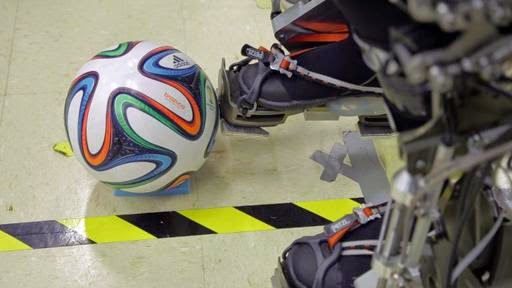
Undated handout picture showing a Brazuca football beside an exoskeleton
at Brazilian scientist Miguel Nicolelis' lab in Sao Paulo, Brazil

The first kick at the World Cup opening ceremony will be made by a paraplegic wearing an Iron Man-like robotic bodysuit controlled by signals from the brain.

Brazilian doctor Miguel Nicolelis led a team of 156 scientists from around the world to create the futuristic exoskeleton, which was designed to enable paralysis victims to walk.

At the World Cup opening ceremony Thursday in Sao Paulo, a paraplegic whose identity has been kept secret will leave behind his or her wheelchair to take to the pitch in the suit and give the tournament's first kick.

Undated handout picture showing scientists
 at work at Brazilian scientist Miguel Nicolelis'
lab in Sao Paulo, Brazil.
Electronic circuits in the device's "feet" will send a return signal to the user via an artificial skin worn on the arm, conveying the sensation of movement and contact.

"It's the first time an exoskeleton has been controlled by brain activity and offered feedback to the patients," Nicolelis, a neuroscientist at Duke University, told AFP.

"Doing a demonstration in a stadium is something very much outside our routine in robotics. It's never been done before."

His voice contains a mix of exhaustion and excitement, the result of 30 years' work, more than 200 scientific papers and countless clinical tests that are nearing a spectacular summit.
Nicolelis started down this path in 1984 when he wrote his doctoral thesis on neural connections in muscular control.

He said the idea for the suit came to him in 2002, when scientists were just beginning to explore robotic exoskeletons.

"In 2009, after we learned Brazil was hosting the World Cup, they asked me for ideas to show Brazil in a different way than the world usually sees it. That's when I suggested doing a scientific demonstration to teach people that Brazil is investing and has human potential to do things beyond football," he said.

Undated handout picture showing
 Brazilian scientist Miguel Nicolelis at
his lab in Sao Paulo, Brazil.
Nicolelis said he and a team of some 40 people have barely left the lab since March, when they arrived in Sao Paulo, Brazil's largest city and economic hub, to finalize preparations.

But it's been rewarding, too, he said, recalling the moment on April 24 when a paralyzed user first took steps in the exoskeleton.

They named the device the BRA-Santos Dumont, a combination of the three-letter sporting code for Brazil and Alberto Santos-Dumont, a Brazilian aviator, inventor and bon vivant who once demonstrated controllable flight was possible by flying his dirigible around the Eiffel Tower.

Scientific controversy

Some scientists have criticized Nicolelis for ditching academic publications in favor of mass media -- he posts research updates on Facebook -- and the anonymity of the lab for the lights of the World Cup stage.

Undated handout picture showing a 
paraplegic patient (L) wearing an interface
 helmet being prepared for a test at
Brazilian scientist Miguel Nicolelis' lab
in Sao Paulo,Brazil.
Critics have also questioned the practicality of his research and accused him of hogging an unfair share of the Brazilian government's research budget. Nicolelis rejects that criticism.

"The funding is the same with or without the World Cup. We've received $14 million from the Brazilian government over the last two years. That's approximately four or five times less than what the United States government invests in a mechanical arm," he said.

"I don't see anything wrong with demonstrating a technology for the whole world that has a humanitarian objective and was paid for by civil society," he added.

More than 65,000 people will be in Sao Paulo's Corinthians Arena to watch the BRA-Santos Dumont's first steps in public before Brazil play Croatia in the opening match. Around a billion are expected to watch on TV.


Sunday, May 25, 2014

1st Mini Dialysis Machine For Babies Developed In Italy Could Help Treat Infants With Kidney Failure

Medical Daily, Justin Caba, May 23, 2014

Italian researchers develop miniaturized
 dialysis machine for treating infants with
 kidney failure. (Photo courtesy of
 Shutterstock)
Treating infants suffering from kidney complications with standard-sized dialysis machines has proven problematic due to accuracy issues with height and weight. Although the number of newborns dealing with kidney failure is fairly limited, a viable treatment option is still vital to their quality of life. An Italian research team, led by Dr. Claudio Ronco of the San Bortolo Hospital in Vicenza, has become the first to develop a miniaturized dialysis machine sufficient in treating babies under 22 lbs.

"This is a pretty major advance for the smallest infants," Dr. Bethany Foster, associate professor of pediatrics at the Montreal Children's Hospital in Canada, said in an accompanying commentary. "I can't imagine the baby they (treated) would have survived with the current technology. You have to be especially vigilant with very small babies because what you're often doing amounts to heroic treatment," Foster said. "We need to be careful that we don't just do things because we can."

The Cardio-Renal Pediatric Dialysis Emergency Machine (CARPEDIEM) was first used back in August of last year to treat a 3-day-old infant weighing around 6.6 lbs., who was suffering from multiple organ failure, the Associated Press reported. Prior to the treatment, the infant’s condition was so severe that Ronco declared, “this baby was almost dead.” Following 25 days of dialysis treatment with the CARPEDIEM, the infant’s organ function was restored and she was discharged from the hospital with mild renal deficiency that did not require renal replacement therapy. So far around 10 newborns across Europe have been treated by the CARPEDIEM.

"We have shown how the technical challenges of providing CRRT can be overcome without relying on the adaptation of technology used in adult settings, and that a CRRT device designed specifically for use in neonates and small children can be used to safely and effectively treat acute kidney injury in small pediatric patients,” Ronco explained. “We hope that our success will encourage the development of other medical technologies specifically designed for infants and small children."

Currently, the standard form of treatment for infants less than 33 lbs. suffering from kidney failure involves a continuous renal replacement therapy (CRRT) machine. Waste products from the blood are removed via a catheter that is inserted into the abdomen. Unfortunately, newborns with low-birth weight are sometimes too small for this method to be effective. In some cases, too much fluid is withdrawn, leading to dehydration and a drop in blood pressure, or too little fluid is withdrawn, leading to high blood pressure and swelling caused by excess fluid.

Tuesday, March 18, 2014

Toshiba unveils disease-detecting breathalyser

Google – AFP, 18 March 2014

Japan's electronics giant Toshiba unveils the prototype model of a breathalyser
 which can detect a wide range of diseases just 30 seconds after users blow into
 the machine, at the company's headquarters in Tokyo, on March 18, 2014 (AFP,
Yoshikazu Tsuno)

Tokyo — Japan's Toshiba on Tuesday unveiled a breathalyser which it says can detect a wide range of diseases just 30 seconds after users blow into the machine.

The device, about the size of a small dishwasher, has a nozzle in which users blow several times.

It then analyses the puffs for traces of several gases which can signal the presence of several health problems including diabetes, stomach ailments and even the ordinary hangover.

"A breath exhaled into the machine is irradiated with an infrared laser, and then trace gases are detected" the company said in a statement.

The gases include acetaldehyde, methane and acetone, all of which can point to the presence of various health problems.

Toshiba said it would expand the number of gases -- and diseases -- that its machine can detect, with an eye to starting commercial production next year.

The healthcare segment is a key unit for Toshiba, which is best known for its consumer electronics.

Sunday, September 15, 2013

China to phase out mercury-based medical equipment

Want China Times, Staff Reporter 2013-09-15

A mercury thermometer. (Photo/Xinhua)

In line with the WTO's Green Medical Care program, China is slated to phase out mercury-based thermometers and blood-pressure monitors by 2020, creating substantial demand for electronic versions of such products.

The replacement of mercury-based thermometers, numbering some 50 million devices in China now, is the first step in the nation's medical greening. Hospitals alone account for 35 million of the devices.

The program was launched by the WTO and international coalition Health Care Without Harm jointly in July 2008, aiming to substitute electronic devices for at least 70% of existing mercury-based thermometers and blood-pressure monitors by 2017. In January this year, China became a signatory to the Anti-Mercury UN Minimata Convention, pledging to ban production and sales of mercury-based thermometers and blood-pressure monitors entirely by 2020.

Jishuitan Hospital in Beijing pioneered the movement in 2008, when it replaced mercury-based thermometers with electronic ones entirely. The upgrade cost 1.2 million (US$196,000). Growing numbers of other hospitals, mainly in first- and second-tier cities, have joined the movement.

According to the Anti-Mercury UN Minimata Convention, China has pledged to replace some 7 million mercury-based thermometers at Chinese hospitals by 2017; up to now, only 300,000 have been replaced. Based on 100 yuan for an electronic thermometer, the move will create 700 million yuan (US$114.39 million) in business opportunities. The market scale will top 3.5 billion yuan (US$572 million) by 2020, if China fulfills its commitment to reaplce the 35 million mercury-based thermometers in its hospitals. The figure nears 10 billion yuan (US$1.63 billion) after taking blood-pressure monitors into account.

Competition will be acute and is expected to drive down electronic device prices by 50%, according to a manager of Omron Healthcare China.