(Subjects: Religion/Worship, Lightworkers, Food, Health, Prescription Drugs, Homeopathy, Innate (Body intelligence), New Age movement, Global Unity, ... etc.) - (Text version)

“…… Should I use Doctors and Drugs to Heal Me or Spiritual Methods?

"Dear Kryon, I have heard that you should stay natural and not use the science on the planet for healing. It does not honor God to go to a doctor. After all, don't you say that we can heal with our minds? So why should we ever go to a doctor if we can do it ourselves? Not only that, my doctor isn't enlightened, so he has no idea about my innate or my spiritual body needs. What should I do?"

First, Human Being, why do you wish to put so many things in boxes? You continue to want a yes and no answer for complex situations due to your 3D, linear outlook on almost everything. Learn to think out of the 3D box! Look at the heading of this section [above]. It asks which one should you do. It already assumes you can't do both because they seem dichotomous.

Let's use some spiritual logic: Here is a hypothetical answer, "Don't go to a doctor, for you can heal everything with your mind." So now I will ask: How many of you can do that in this room right now? How many readers can do that with efficiency right now? All of you are old souls, but are you really ready to do that? Do you know how? Do you have really good results with it? Can you rid disease and chemical imbalance with your mind right now?

I'm going to give you a truth, whether you choose to see it or not. You're not ready for that! You are not yet prepared to take on the task of full healing using your spiritual tools. Lemurians could do that, because Pleiadians taught them how! It's one of the promises of God, that there'll come a day when your DNA works that efficiently and you will be able to walk away from drug chemistry and the medical industry forever, for you'll have the creator's energy working at 100 percent, something you saw within the great masters who walked the earth.

This will be possible within the ascended earth that you are looking forward to, dear one. Have you seen the news lately? Look out the window. Is that where you are now? We are telling you that the energy is going in that direction, but you are not there yet.

Let those who feel that they can heal themselves begin the process of learning how. Many will be appreciative of the fact that you have some of the gifts for this now. Let the process begin, but don't think for a moment that you have arrived at a place where every health issue can be healed with your own power. You are students of a grand process that eventually will be yours if you wish to begin the quantum process of talking to your cells. Some will be good at this, and some will just be planting the seeds of it.

Now, I would like to tell you how Spirit works and the potentials of what's going to happen in the next few years. We're going to give the doctors of the planet new inventions and new science. These will be major discoveries about the Human body and of the quantum attributes therein.

Look at what has already happened, for some of this science has already been given to you and you are actually using it. Imagine a science that would allow the heart to be transplanted because the one you have is failing. Of course! It's an operation done many times a month on this planet. That information came from the creator, did you realize that? It didn't drop off the shelf of some dark energy library to be used in evil ways.

So, if you need a new heart, Lightworker, should you go to the doctor or create one with your mind? Until you feel comfortable that you can replace your heart with a new one by yourself, then you might consider using the God-given information that is in the hands of the surgeon. For it will save your life, and create a situation where you stay and continue to send your light to the earth! Do you see what we're saying?

You can also alter that which is medicine [drugs] and begin a process that is spectacular in its design, but not very 3D. I challenge you to begin to use what I would call the homeopathic principle with major drugs. If some of you are taking major drugs in order to alter your chemistry so that you can live better and longer, you might feel you have no choice. "Well, this is keeping me alive," you might say. "I don't yet have the ability to do this with my consciousness, so I take the drugs."

In this new energy, there is something else that you can try if you are in this category. Do the following with safety, intelligence, common sense and logic. Here is the challenge: The principle of homeopathy is that an almost invisible tincture of a substance is ingested and is seen by your innate. Innate "sees" what you are trying to do and then adjusts the body's chemistry in response. Therefore, you might say that you are sending the body a "signal for balance." The actual tincture is not large enough to affect anything chemically - yet it works!

The body [innate] sees what you're trying to do and then cooperates. In a sense, you might say the body is healing itself because you were able to give it instructions through the homeopathic substance of what to do. So, why not do it with a major drug? Start reducing the dosage and start talking to your cells, and see what happens. If you're not successful, then stop the reduction. However, to your own amazement, you may often be successful over time.

You might be able to take the dosage that you're used to and cut it to at least a quarter of what it was. It is the homeopathy principle and it allows you to keep the purpose of the drug, but reduce it to a fraction of a common 3D dosage. You're still taking it internally, but now it's also signaling in addition to working chemically. The signal is sent, the body cooperates, and you reduce the chance of side effects.

You can't put things in boxes of yes or no when it comes to the grand system of Spirit. You can instead use spiritual logic and see the things that God has given you on the planet within the inventions and processes. Have an operation, save your life, and stand and say, "Thank you, God, for this and for my being born where these things are possible." It's a complicated subject, is it not? Each of you is so different! You'll know what to do, dear one. Never stress over that decision, because your innate will tell you what is appropriate for you if you're willing to listen. ….”

Monsanto / GMO - Global Health


(Subjects: Big pharma [the drug companies of America] are going to have to change very soon or collapse. When you have an industry that keeps people sick for money, it cannot survive in the new consciousness., Global Unity, ... etc.) - (Text version)
"Recalibration of Free Choice"– Mar 3, 2012 (Kryon Channelling by Lee Caroll) - (Subjects: (Old) Souls, Midpoint on 21-12-2012, Shift of Human Consciousness, Black & White vs. Color, 1 - Spirituality (Religions) shifting, Lose a Pope “soon”, 2 - Humans will change react to drama, 3 - Civilizations/Population on Earth, 4 - Alternate energy sources (Geothermal, Tidal (Pedal wheels), Wind), 5 – Financials Institutes/concepts will change (Integrity – Ethical) , 6 - News/Media/TV to change, 7 – Big Pharmaceutical company will collapse “soon”, (Keep people sick), (Integrity – Ethical) 8 – Wars will be over on Earth, Global Unity, … etc.) - (Text version)
"The Recalibration of Awareness – Apr 20/21, 2012 (Kryon channeled by Lee Carroll) (Subjects: Old Energy, Recalibration Lectures, God / Creator, Religions/Spiritual systems (Catholic Church, Priests/Nun’s, Worship, John Paul Pope, Women in the Church otherwise church will go, Current Pope won’t do it), Middle East, Jews, Governments will change (Internet, Media, Democracies, Dictators, North Korea, Nations voted at once), Integrity (Businesses, Tobacco Companies, Bankers/ Financial Institutes, Pharmaceutical company to collapse), Illuminati (Started in Greece, Shipping, Financial markets, Stock markets, Pharmaceutical money (fund to build Africa, to develop)), Shift of Human Consciousness, (Old) Souls, Women, Masters to/already come back, Global Unity.... etc.) - (Text version)
"THE BRIDGE OF SWORDS" – Sep 29, 2012 (Kryon channeled by Lee Carroll) (Subjects: ... I'm in Canada and I know it, but I will tell those listening and reading in the American audience the following: Get ready! Because there are some institutions that are yet to fall, ones that don't have integrity and that could never be helped with a bail out. Again, we tell you the biggest one is big pharma, and we told you that before. It's inevitable. If not now, then in a decade. It's inevitable and they will fight to stay alive and they will not be crossing the bridge. For on the other side of the bridge is a new way, not just for medicine but for care. ....) - (Text Version)

Pharmaceutical Fraud / Corruption cases

Health Care

Health Care
Happy birthday to Percy Julian, a pioneer in plant-drug synthesis. His research produced steroids like cortisone. (11 April 2014)
Showing posts with label Water Supply. Show all posts

Saturday, March 21, 2015

Amsterdam installs drinking water fountains in anti-obesity campaign

DutchNews.nl, March 20, 2015

Amsterdam city council is placing 300 drinking water fountains around the capital in an effort to encourage children to drink water rather than sugary drinks. 

The plan is part of the city’s efforts to reduce childhood obesity. Some 160 drinking water fountains have already been installed and a further 40 are at the planning stage. The rest will be set up in the coming years.

Figures from the city’s health board show one in five Amsterdam children is overweight. 

Intensive efforts to encourage children to exercise and eat more healthily are beginning to pay off, alderman Eric van der Burg said on Friday. 

The number of overweight five year olds has gone down by 2% over the past two years, he said. However, 30,000 children are still too heavy and 2,300 are obese.

Part of the problem is in cultural differences, Van der Burg said. ‘Richer families in the centre buy water but poorer families like to think they are rich enough to buy cola and not to drink water out of a tap,’ the Parool quotes him as saying.

Thursday, January 1, 2015

Antibiotic makers polluting China's drinking water: CCTV

Want China Times, Staff Reporter 2015-01-01

A pharmacist in Meishan, Sichuan province. (File photo/Xinhua)

Antibiotics producers in China are suspected of dumping waste water and polluting the country's drinking water sources, reports national broadcaster China Central Television (CCTV).

Following an investigation into pollution emitted from antibiotics producers around the country, CCTV came out with the results of samples taken from drinking water, drains and water sources near factories and livestock farms. Even water in the vicinity of the Jining factory of Shandong Lukang Pharmaceutical, previously considered a leader in pollution prevention facilities, was found containing the highest levels of antibiotics in the study. The Ministry of Environmental Protection has sent a team to the city for further investigation.

Other water samples, especially those taking from water near major antibiotic factories, tested positive for antibiotics.

The company is one of four major antibiotic producers in China. Its 2013 financial report shows 222 million yuan (US$35 million) of its 1.44 billion yuan (US$231 million) revenue came from active ingredients while another 227 million yuan (US$36 million) came from semi-synthetic active ingredients and 970 million (US$155 million) from medicines.

According to the China Chamber of Commerce of Medicine & Health Products Importers and Exporters, China produced 121,200 tons of antibiotics in 2013 and exported 34,300 tons, or US$2.19 billion in value. The active ingredients produced in the country amounted to 70% of the global market.

Active ingredients are costly and energy intensive to manufacture. Developed countries have been focusing on producing high-end antibiotic products and have relocated the production of active ingredients to other countries. The active ingredients of multinational pharmaceutical companies are typically manufactured in emerging countries. Around 180 million yuan (US$28 million) of Shandong Lukang Pharmaceutical's revenue in 2013 came from other countries.

Cai Dongchen, chairman of CSPC Pharmaceutical Group, said active ingredient manufacturing is inefficient and water treatment is costly. China also lacks the technologies and equipment for cleaning the materials during the production process, said the chairman.

Sources familiar with Shandong Lukang Pharmaceutical said Chinese antibiotic producers will, like their European counterparts, be forced to relocate production sites if national environmental protection standards are stringently enforced.

Stuck in the upstream production process leaves the industry will little room for profit on manufacturing low-end active ingredients. Tighter government controls on the use of antibiotics are further squeezing industry margins. Antibiotic uses in hospitals have dropped from 68% in 2010 to 53.5% in 2013, according to the report.

Some antibiotic producers are redirecting funds set aside for saving energy and reducing carbon emissions to improving their production in order to compete on the market, said an industry insider.

Thursday, May 15, 2014

Alfredo Zolezzi: how a plasma water purifying system is saving lives

Wired.co.uk, Nicholas Tufnell, 17 October 2013


"If we can connect people and their needs with the advancement of technology we will make a better world" claims Alfredo Zolezzi during his talk at Wired 2013.

Zolezzi is a Chilean industrial designer and an expert in applied technological innovations. He has created an integrated objectives model which he says allows for him to improve technological innovation and create greater social, emotional and developmental impact.

Alfredo Zolezzi (Nate Lanxon)
"For many years I was involved in innovation, but I discovered I was using 80 percent of my time just surviving and had little time to create," explains Zolezzi. "So I decided to study the innovation models that were already out there, but there were none. So I wrote my own innovation model and soon after I started creating some of my most effective products."

Zolezzi soon developed technology that enhanced the recovery of oil from abandoned oil wells "using high-frequency and high-powered ultrasound waves." He wished to innovate further to create new technologies that could significantly reduce the cost of refining oil, but something held him back.

"I could have made billions," he said, "but there is no future if we do not change the way we are addressing our current problems. Only 2.5 billion people have to access to clean water, we cannot ignore that reality. We are living the future but we are still struggling with the problems from the past."

Wishing to refocus his efforts on humanitarian needs, Zolezzi set out to create a novel way of purifying water. The answer was found in plasma.

Zolezzi created a plasma sanitation system that can sanitise 35 litres of water in five minutes at a cost per litre of less than one penny. The system injects water into a reaction chamber, where it achieves plasma state through a high-intensity electrical field. The microbiological content of the water is then eliminated by electroporation, oxidation, ionization, UV and IR radiation.

"This technology won't remove impurities like salt or heavy metals, but it will kill bacteria," Zolezzi explained. "In our last test, the plasma procedure killed off 100 percent of bacteria with 100 percent efficacy."

The system has been used in a Chilean slum, where Zolezzi says it has "improved their health, dignity and quality of life in an instant".

Zolezzi closed his speech remarking that his technology alone isn't enough, it's crucial that social technology is used in conjunction with this his new device to ensure people are aware of its existence and importance. He left the stage reminding us to "just think that there is always someone who is not as privileged as we are. We have problems, but all this privilege that we have is also our commitment".


“… New ideas are things you never thought of. These ideas will be given to you so you will have answers to the most profound questions that your societies have had since you were born. Inventions will bring clean water to every Human on the planet, cheaply and everywhere. Inventions will give you power, cheaply and everywhere. These ideas will wipe out all of the reasons you now have for pollution, and when you look back on it, you'll go, "This solution was always there. Why didn't we think of that? Why didn't we do this sooner?" Because it wasn't time and you were not ready. You hadn't planted the seeds and you were still battling the old energy, deciding whether you were going to terminate yourselves before 2012. Now you didn't…. and now you didn't.

It's funny, what you ponder about, and what your sociologists consider the "great current problems of mankind", for your new ideas will simply eliminate the very concepts of the questions just as they did in the past. Do you remember? Two hundred years ago, the predictions of sociologists said that you would run out of food, since there wasn't enough land to sustain a greater population. Then you discovered crop rotation and fertilizer. Suddenly, each plot of land could produce many times what it could before. Do you remember the predictions that you would run out of wood to heat your homes? Probably not. That was before electricity. It goes on and on.

So today's puzzles are just as quaint, as you will see. (1)How do you strengthen the power grids of your great nations so that they are not vulnerable to failure or don't require massive infrastructure improvement expenditures? Because cold is coming, and you are going to need more power. (2) What can you do about pollution? (3) What about world overpopulation? Some experts will tell you that a pandemic will be the answer; nature [Gaia] will kill off about one-third of the earth's population. The best minds of the century ponder these puzzles and tell you that you are headed for real problems. You have heard these things all your life.

Let me ask you this. (1) What if you could eliminate the power grid altogether? You can and will. (2) What if pollution-creating sources simply go away, due to new ideas and invention, and the environment starts to self-correct? (3) Overpopulation? You assume that humanity will continue to have children at an exponential rate since they are stupid and can't help themselves. This, dear ones, is a consciousness and education issue, and that is going to change. Imagine a zero growth attribute of many countries - something that will be common. Did you notice that some of your children today are actually starting to ponder if they should have any children at all? What a concept! ….”


“… Ideas and Inventions Are Not Random

Now, I want to revisit this because we're coming to the point of what I want to speak of, which we have not spoken of before. It seems unbelievable, but the fact is that ideas and inventions are given to the planet when it's ready, and not before. We told you last time that humanity believes it can "think of anything." The intellectual believes the sky is the limit in creativity. Yet, isn't it interesting that everything profound in ideas and inventions has come almost at the last moment? When you take a look at humanity and how long you've been here and how long there have been smart Human Beings, why is it that only in the last seeming second of time that almost all modern invention took place?

Imagine going through thousands of years without understanding what a bacteria was, or not believing in germs, or not having electricity. When you think about these things and the order in which they came to the planet, it's quite revealing. Many Humans were working on the same invention at the same time and didn't even know it. Suddenly, you received the invention of radio, then pictures that fly through the air, then flight. It all came together seemingly in the last moment. You've got to ask, do you not, how logical is this in the scheme of how things work? Did you have to come to a certain point in history before Humans got smart? Or do you think there was something else going on? The answer is there was something else going on. It seemed as though these ideas were being "delivered" to the planet all at the same time, and many were understanding these things suddenly all at once.

The Time Capsules

Here is what happened: Within that which you call Gaia, there is the Crystalline Grid. This is the memory of all things placed there by the Pleiadians. The Crystalline Grid was created for this purpose by the Pleiadians. When it's proper and when humanity's consciousness has reached a certain point, these ideas are released. It is a time capsule of invention and more. This does not happen from the great central sun; it does not happen from outside the earth, but rather it happens from within. …”

Sunday, May 11, 2014

Prescription drugs polluting China's surface water

Want China Times, Staff Reporter 2014-05-11

55-year-old environmental protection worker Hu Yuanbao picks up trash on the
 shore near the mouth of the Huangpu River in Shanghai, July 4, 2013.
(File photo/Xinhua)

China's surface waters have been polluted by multiple pharmaceutical and personal care products including 68 types of antibiotics and 90 types of non-antibiotics, reports Beijing-based Caixin Media, one of the country's leading financial news providers, citing a joint study by the East China University of Science and Technology, Tongji University and Tsinghua University published in Chinese science journal Science China on April 28.

Pharmaceutical and personal care products are micro-organic pollutants that have raised concern among both academics and the public due to their effect on human health and the environment. The substances have been found in wastewater, surface water, ground water and soil. The United Nations Environment Programme has expressed concern over the influence of these products such as painkillers and antibiotics on water resources.

The frequency and the concentration of these products found in surface water in China has been much higher than they have in Western countries. Antibiotics Sulfamethoxazole and Sulfapyridine have been found in samples from the Huangpu River. All the samples taken from the river during low water period have traces of sulfamethoxazole with concentrations ranging between 14.9 to 623.3 nanograms, much higher than those recorded in Japan and the United States.

Although less than 60% of the samples taken contained non-antibiotic pharmaceuticals and personal care products, many common medicines such as anti-inflammatory medicines, anticonvulsant drugs, hormones and medicines used to lower blood pressure, blood lipids and reduce bacteria were found in the samples.

These findings suggest severe abuse of additives in animal feed and prescription drugs in China. Most of these substances come from wastewater produced by members of the public, medical institutions, factories, the agricultural husbandry and fisheries industries as well as landfills, according to the study. A concentration of sulfamethoxazole up to 1,080 nanograms per liter was recorded from a sample taken from a section of the River Zhu. The high level of the antibiotic found in the region might have to do with the heavy use of additives in the feed and preventative medicines in local chicken farms.

Saturday, April 12, 2014

Excessive benzene found in NW China tap water

Want China Times, Xinhua 2014-04-12

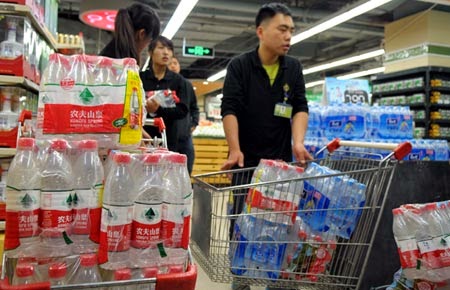
Lanzhou citizens rush to buy lots of bottled water at Hualian Supermarket,
April 11. (Photo/Xinhua)

Excessive levels of benzene in tap water have affected more than 2.4 million people in downtown Lanzhou, in northwestern China's Gansu province, provincial authorities said on Friday.

Tests on Friday showed tap water contained 160 micrograms of benzene per liter, far in excess of the 10 micrograms per liter national limit, according to the city's environmental protection office.

The city government warned citizens not to drink tap water for the next 24 hours. Benzene is a colorless carcinogen used in the manufacture of plastics.

Tests on Thursday and Friday found between 118 micrograms to 200 micrograms of benzene per liter, according to Veolia Water, a Sino-French joint venture and the sole water supplier for urban Lanzhou, the provincial capital.

An initial investigation found problems in a 3 km channel which links the plant that preprocesses the water and the plant that supplies water to Lanzhou. Closure of the channel will cut the city's water supply by half, said Tian Hong, head of Lanzhou's water quality monitoring station. Fire engines will be used to carry water to affected areas.

The local government is investigating the source of the contamination, and sources with Veolia told Xinhua that they believed that the benzene came from chemical waste, but refused to single out any particular plant. They denied any possibility that the Yellow River, the original source of the water, was polluted. Gansu's publicity department reaffirmed on Friday afternoon that the Yellow River, which runs through the city, is not contaminated.

Lanzhou residents panicked upon hearing the news, rushing to supermarkets and grocery stores to stock up on bottled water. At Hualian Supermarket, one of the largest in downtown Lanzhou, many trolleys were piled with cases of bottled water. Latecomers gathered in front of empty shelves, waiting for resupply.

"I had no idea what benzene was, but my family are all scared. My husband called to ask me to buy as much bottled water as I can," a shopper told Xinhua.

This is the second incident of its kind in Lanzhou in two months. On March 6, residents reported a strange odor when they turned on their taps, which was later confirmed to be a high concentration of ammonia, although it was within the limits of the national standards.

Related Article:


Friday, August 30, 2013

Wave goodbye to global warming, GM and pesticides

Radio wave-treated water could change agriculture as we know it. Its Irish pioneers meet Tom Prendeville

Independent.ie, 25 August 2013

MIRACLE GROW: Treated water results
 in larger, healthier crops, says Professor
Austin Darragh of Limerick University
A GROUNDBREAKING new Irish technology which could be the greatest breakthrough in agriculture since the plough is set to change the face of modern farming forever.

The technology – radio wave energised water – massively increases the output of vegetables and fruits by up to 30 per cent.

Not only are the plants much bigger but they are largely disease-resistant, meaning huge savings in expensive fertilisers and harmful pesticides.

Extensively tested in Ireland and several other countries, the inexpensive water treatment technology is now being rolled out across the world. The technology makes GM obsolete and also addresses the whole global warming fear that there is too much carbon dioxide in the air, by simply converting excess CO2 into edible plant mass.

Developed by Professor Austin Darragh and Dr JJ Leahy of Limerick University's Department of Chemistry and Environmental Science, the hardy eco-friendly technology uses nothing but the natural elements of sunlight, water, carbon dioxide in the air and the minerals in the soil.

The compact biscuit-tin-sized technology, which is called Vi-Aqua – meaning 'life water' – converts 24 volts of electricity into a radio signal, which charges up the water via an antennae. Once the device is attached to a hose, thousands of gallons of water can be charged up in less than 10 minutes at a cost of pennies.

Speaking about the new technology, Professor Austin Darragh says:

"Vi-Aqua makes water wetter and introduces atmospheric nitrogen into the water in the form of nitrates – so it is free fertiliser. It also produces the miracle of rejuvenating the soil by invigorating soil-based micro-organisms.

"We can also make water savings of at least 30 per cent. When the water is treated it becomes a better solvent, which means it can carry more nutrients to the leaves and stem and percolate better down into the soil to nourish the roots, which in turn produces a better root system. Hence the reason you need less water and why you end up with larger and hardier crops," explains Professor Austin Darragh.

Extensively tested in Warrenstown Agricultural College, the technology is being hailed as a modern day miracle.

Harold Lawler is Ireland's foremost Agricultural Specialist. As Director of the National Botanical Gardens and former Master of Agricultural Science at Warrenstown Agricultural College, he has carried out more research on Vi-Aqua growth-enhancing technology than perhaps anyone else in the world:

"In the bedding plants we really saw a difference in the results; they were much hardier and tougher. You could drop a tray of these plants on the ground and they would not shatter, like ordinary plants.

"We also noticed that the treated plants needed far less fertiliser than the untreated ones. The roots took the nutrients in better whereas with other normal plants leaching of minerals occurs," explains Harold Lawler.

Impressed, Harold Lawler's research team carried out further extensive tests on a wide variety of vegetable plants:

"The iceberg lettuces were far superior with faster germination, and with carrots for example, the crops were on average 46 per cent heavier," explains Harold Lawler.

During recent successful tomato crop field trials in Italy, three of the country's largest Agricultural Co-op's were so impressed with the results that they have now decided to recommend the technology to the country's farming community.

Elsewhere, the Indian government have now concluded their own tests, which confirm that they are able to boost tea (plant) production by over a third while using far less water.

In recognition of the groundbreaking technology, the Royal Botanical Gardens at Kew, London, recently took the hitherto unheard-of step of granting Professor Austin Darragh and his team the right to use their official centuries-old coat of arms on the new technology – the first time ever that Kew Gardens has afforded anyone such an honour.

The Kew Gardens botanists were not just impressed with the research; they used the technology to restore to life a very rare orchid which had been lying dormant and practically dead in a greenhouse bell jar since 1942. Amazingly, the orchid is now flourishing once again.

Intriguingly, chickens and sheep fed the energised water turned into giants. . . but that's another story!

Limerick University off- campus company ZPM Europe Ltd, who are based in the National Technology Park, Limerick, is now manufacturing the Vi-Aqua technology.

Sunday Independent

Saturday, March 19, 2011

Traces of radioactive iodine found in tap water in Tokyo

Antara News, Sat, March 19 2011
Tokyo (ANTARA News/Kyodo-OANA) - Slight amounts of radioactive iodine have been detected in tap water in Tokyo, its vicinity and most prefectures neighboring Fukushima apparently due to the nuclear crisis at the Fukushima Daiichi nuclear power plant, the government said Saturday.

While the substance was found in Tochigi, Gunma, Niigata, Chiba and Saitama prefectures as well as Tokyo, traces of cesium have also been found in tap water in two of them -- Tochigi and Gunma, the Ministry of Education, Culture, Sports, Science and Technology said, adding their levels do not affect human health even if they are taken in.

Among them, Tochigi, Gunma and Niigata border Fukushima Prefecture.

In Maebashi, Gunma, 2.5 becquerels of iodine and 0.38 becquerel of cesium were detected Friday per kilogram of water, the prefectural government said, adding it is the first time the substances were found since it began testing tap water for radioactive materials in 1990.

The Nuclear Safety Commission of Japan limits an intake of iodine at 300 becquerels per kilogram of water and of cesium at 200 becquerels.

Editor: Priyambodo RH

Related Articles:

Monday, March 22, 2010

World Water Day

The Jakarta Post, Mon, 03/22/2010 3:00 PM


World Water Day: An activist sports in a mascot costume during a rally to commemorate World Water Day, which falls on March 22, at the Hotel Indonesia traffic circle in Central Jakarta, on Monday. The protesters urged the government to supply clean water to its people. Antara/Ujang Zaelani


Monday, December 7, 2009

India's Tata launches water filter for rural poor


Tata Group boss Rajan Tata launches the purifier

The Indian industrial conglomerate Tata Group has launched a new low-cost water purifier, aimed at lower-income households in rural areas.

The Tata 'Swach' purifier is less than one metre tall, and does not need running water or electricity to work.

The firm is hoping to revolutionise the business of providing clean water, a lack of which affects almost one billion people globally.

Tata says the device is the result of a decade of research and development.

The Tata Group includes India's largest carmaker Tata Motors, and also has interests in steelmaking, IT, and chemicals.

Its Swach water device - named after the Hindu word for clean - will cost under 1,000 rupees ($21.5; £13), according to one Indian report.

It uses ash from rice milling to filter out bacteria, and also uses tiny silver particles to kill harmful germs that can lead to diseases like diarrhoea, cholera and typhoid.

The health consequences of poor water quality are enormous for developing countries like India, with millions of people affected.

Trying to provide safe drinking water for them has cost the government billions of rupees, but it continues to be a major hurdle.


Saturday, December 5, 2009

Most tap-water companies in `bad shape'

Fadli, The Jakarta Post, Batam | Sat, 12/05/2009 1:40 PM

The majority of tap-water companies (PDAM) across Indonesia are managed poorly due to political moves made by regional administrations, says an executive.

Saiful, new chairman of the Indonesian Tap-Water Companies' association (Perpamsi), said that of 355 PDAMs across the country, only 25 percent were in a good condition both in term of finance and management, while the remaining 75 percent were in bad shape.

"The quality of human resources, financial deficit, high level of pipeline leakages and political attitudes from regional administration heads have been blamed for the *PDMs'* conditions," said Saiful, who had just been elected as chairman of Perpamsi for the 2009-2013 term, on Thursday, during the organization's meeting in Batam, Riau Islands province.

Among the political maneuvers blamed for the conditions, according to Saiful, were the appointments of PDAM's employees that were based more on nepotism rather than competence.

"Rates are also something that is often *played with' by heads of regional administrations, especially during the campaign period. As a result, PDAMs cannot decide their own rates according to their calculations," said Saiful who is also president director of PDAM Tirta Musi in Palembang, South Sumatra.

Saiful said the combined debt of all PDAMs across the country, which mostly operate in provincial and regency/municipal capitals, totalled Rp 6 trillion.

"In a bid to help rectify the situation we will conduct some programs including improving the quality of our staff through training and conducting fit-and-proper tests on candidates for PDAM executive positions," he said.

Separately, Perpamsi vice chairman Sunarto Mokodompit, who is also president director of PDAM Bolaang Mongondow, said political pressure from the regency head made it difficult to restructure human resources in his company.

"The Regent often called me to accept this person or that person as an employee at my office. I can't refuse, if I do I'll probably end up losing my job," he said.

A similar scenario was expressed by Ricky Pontoh, president director of PDAM North Minahasa. He said most of the PDAMs set up in new regencies in his region were being run by staff with no experience in clean water management.

"The conditions of the PDAMs in those areas, which were previously under our management, are really concerning at the moment," he said.

Saiful also said that with regard to the present conditions, Indonesia would not meet the Millennium Development Goals (MDG) target of increasing access to clean water and basic sanitation facilities by 2015.

The MDG has set a target of sustainable access to clean water for 80 percent of the urban populations and 60 percent of the rural residents by 2015.

Currently, he said, it was almost certain that the target would not be achieved. Only 40 percent of the urban population and less than 30 percent of the rural population had sustainable access to clean water, he added.

Former vice president Jusuf Kalla said that between 2008 and 2013, 10 million households would be provided with clean water installations. Currently 7.1 million installations have been delivered. "It's even difficult to meet the former vice president's target," Saiful said.


Friday, December 4, 2009

Yudhoyono asks women’s groups for help on MDGs

Erwida Maulia, The Jakarta Post, Jakarta | Thu, 12/03/2009 9:35 AM

President Susilo Bambang Yudhoyono has asked women’s organizations to help the country meet the Millennium Development Goals (MDGs) by 2015.

The President said, while officially opening the 23rd congress of the Indonesian Women’s Congress (Kowani), that at least three out of eight MDGs were related closely to women, namely those to pro-mote gender equality and empower women, to reduce infant mortality rates, and to improve maternal health.

Kowani claims connection with more than 80 women’s organizations, with a total of 30 million members nationwide. The congress, running from Dec. 2 to 4, is themed “Kowani and women’s commitment to achieving the MDGs”.

“I’m pleased [with the theme chosen] because it is what the government I lead has been occupied with days and nights — to achieve the MDGs,” Yudhoyono said Wednesday at the Presidential Palace, where he hosted congress’ participants from across Indonesia.

“Over the next five years, I want Kowani, with its [upcoming] leadership and structure, to accompany the government and, along with other civil society groups, lead efforts to help the country meet the MDGs,” he said.

In relation to the gender-equality target, the President reiterated his call to all state officials not to discriminate against women in implementing their education and health policies.

As for reducing the child mortality rate and improving maternal health, he said that although Indonesia now enjoyed much better conditions compared to 50 years ago, the rates remained “unsatisfactory“.

Yudhoyono said this was why he had appointed Endang Sedyaningsih — who earned her master’s and doctoral degrees in public healthcare at Harvard University — as the health minister in the new Cabinet.

“I appointed a health minister with a background in public health, because I wanted Indonesia to meet the MDGs, and see public health improved,” Yudhoyono said.

The President also called on Kowani members to support campaigns to protect the environment and fight global warming, with Indonesia among countries expected to be hardest hit by the greenhouse effect.

“If the global temperatures continue to increase and the polar ice caps melt, the sea levels will rise… We currently have more than 17,000 islands... would we want a few thousand of them inundated in several years from now?” he said.

“This is not to mention the impacts from climate change which produces long draughts and floods. That is why I ask you, let us show more concern toward the environment.

“We can plant trees, apply waste management, conserve water… Kowani can ask its members to play active roles,” he said.

Kowani was founded in 1928, and has often been dubbed a mere gathering place for wives of state officials.

However, its current chairwoman, Linda Amalia Sari, said the organization had been involved in the formation of new legislation affecting women and children, particularly over the past five years.

Linda, the wife of senior politician Agum Gumelar, was appointed as the state women’s empowerment and child protection minister because of her involvement in Kowani.


Wednesday, December 2, 2009

RI warned of missing 2015 clean water target

Fadli, The Jakarta Post , Batam, Riau Islands | Wed, 12/02/2009 9:56 PM

Indonesia is likely to fall short of achieving its Millennium Development Goal (MDG) target of significantly improving access to clean water and sanitation facilities by 2015, warns the Association of All Indonesian Tap Water Companies (Perpamsi).

Poor clean water management, leakages and wasteful use of water are likely to cause the failure, it added.

Perpamsi head, Achmad Marju Kodri, told The Jakarta Post on the sidelines of the 11th Tap Water Company Conference in Batam, Riau Islands, on Wednesday that Indonesia had set its MDG target to ensure that 80 percent of urban dwellers and 60 percent of rural communities, which make up the total population, would have sustainable access to clean water by 2015.

However, the target is challenging as currently only 40 percent of urban residents and 30 percent of rural residents have access to potable water, he added.

“Indonesia definitely cannot reach its MDG target in terms of reducing the number of people without access to clean water due to various obstacles, such as poor clean water management and wasteful use of water. It also depends on the goodwill of the government,” said Kodri.

He said that only 60 percent of urban dwellers and 40 percent of rural residents in Indonesia would have access to drinking water.

“Cases of pipe leakages in Indonesia have reached 32 percent, people remain wasteful and most of the state-run tap water company (PDAM) heads in the regions are less professional, so much so that clean water supplies to residents are still ineffective and unequal,” said Kodri.

Monday, March 2, 2009

`Zoo run’ helps provide clean water for schools

The Jakarta Post ,   JAKARTA  |  Mon, 03/02/2009 9:21 AM  
 

 JP/J.Adiguna
 

Jihan Safira, 9, sat and chatted with her school friends at a shelter near an entrance to Ragunan Zoo, South Jakarta, on Sunday morning. 

Her T-shirt, like that of most of her friends, was dripping with sweat after a 3-kilometer run around a track at the zoo. Jihan said she was tired, but had enjoyed the run. 

“We could see several animals and gardens from the track. It was cool,” said the fourth-grader from state elementary school SDN 09 in Pademangan, North Jakarta. 

Jihan was not alone. Dozens of children and adults participated in the “Run for H2O” event at the zoo, which was organized by Helping Hands, a student club from the Jakarta International School, and Jakarta Free Spirit, a running club. 

More than 200 runners from different nationalities took part at the event, which was aimed to raise funds for the Safe Water in Schools program run by Helping Hands to provide clean water to five elementary schools in North Jakarta. 

Sunday’s run included a 21-kilometer half marathon, 10K, 5K and 3K fun runs. Daniel Masrin, 16, the Helping Hands chairman, said his club members were interested in helping provide clean water to elementary schools students in North Jakarta after learning about severe water problems in the area. 

“We learned that school students in North Jakarta had difficulties getting clean water,” he told The Jakarta Post.“We wanted to help them get access to clean water by installing a water tank at their school, so they can drink and wash their hands safely.” 

Barbara Oravetz, Jakarta Free Spirit spokeswoman, supported the students’ program, saying the charity race had received an impressive response from the club’s members. 

Residents of North Jakarta, located near the city’s coastline, have a long-standing problem getting access to clean water. They can no longer use groundwater wells as the wells have been affected by saltwater intrusion and industrial and human waste. The picture shows an official giving a cup of water to a participant.


Tuesday, February 10, 2009

Residents told to brace for leptospirosis in rainy season

The Jakarta Post, JAKARTA | Tue, 02/10/2009 11:01 AM  

During the rainy season, Jakarta residents have to brace for the spread of several water-borne diseases, an official said Monday. 

Leptospirosis is one of them. 

Jakarta has seen two cases of leptospirosis this year, said Tini Suryanti, the head of the city health agency. 

In 2002, during one of the largest floods in Jakarta, 113 patients were infected with leptospira germs according to the agency’s data. Twenty of the patients died. 

Tini said there were 184 cases in 2007 and 41 in 2008. 

“The leptospira bacteria comes from the urine of rats  and is spread by flooding,” she said.

The bacteria easily enters through small wounds, eyes, nose and skin. 

The disease can easily spread at temporary shelters for flood victims because of poor hygiene and sanitation, Tini said. 

“We have conducted information sessions, educating flood victims on personal and public hygiene to prevent the spread of this disease.” 

Wearing closed footwear like boots to wade through floodwater is also recommended. 

According to the June 2007 edition of the University of Indonesia’s health journal, Makara, every animal can potentially be infected with the disease. 

Water sources require special care to prevent contamination. 

The bacteria cannot survive long in salt water, but can live in freshwater for up to a month.

In humans, the incubation period ranges from four to 19 days. Symptoms include fever, headaches, fatigue, vomiting, sore eyes, leg pain and back pain 

If the bacteria enters the liver, a patient’s skin will appear yellow. If the bacteria enters the heart, it could trigger sudden death. 

If the bacteria attacks the lungs, the patient may cough up blood and experience chest pains.

Monday, January 26, 2009

World's highest drug levels entering India stream


The Jakarta Post, Margie Mason, The Associated Press ,Patancheru, Mon, 01/26/2009
  
When researchers analyzed vials of treated wastewater taken from a plant where about 90 Indian drug factories dump their residues, they were shocked. Enough of a single, powerful antibiotic was being spewed into one stream each day to treat every person in a city of 90,000. 

Water tested near Hyderabad
 contains some of the highest 
environmental drug levels known.
MAHESH KUMAR/AP
And it wasn't just ciprofloxacin being detected. The supposedly cleaned water was a floating medicine cabinet — a soup of 21 different active pharmaceutical ingredients, used in generics for treatment of hypertension, heart disease, chronic liver ailments, depression, gonorrhea, ulcers and other ailments. Half of the drugs measured at the highest levels of pharmaceuticals ever detected in the environment, researchers say. 

Those Indian factories produce drugs for much of the world, including many Americans. The result: Some of India's poor are unwittingly consuming an array of chemicals that may be harmful, and could lead to the proliferation of drug-resistant bacteria. 

"If you take a bath there, then you have all the antibiotics you need for treatment," said chemist Klaus Kuemmerer at the University of Freiburg Medical Center in Germany, an expert on drug resistance in the environment who did not participate in the research. "If you just swallow a few gasps of water, you're treated for everything. The question is for how long?" 

Last year, The Associated Press reported that trace concentrations of pharmaceuticals had been found in drinking water provided to at least 46 million Americans. But the wastewater downstream from the Indian plants contained 150 times the highest levels detected in the U.S. 
At first, Joakim Larsson, an environmental scientist at the University of Gothenburg in Sweden, questioned whether 100 pounds a day of ciprofloxacin could really be running into the stream. The researcher was so baffled by the unprecedented results he sent the samples to a second lab for independent analysis. 

When those reports came back with similarly record-high levels, Larsson knew he was looking at a potentially serious situation. After all, some villagers fish in the stream's tributaries, while others drink from wells nearby. Livestock also depend on these watering holes. 

Some locals long believed drugs were seeping into their drinking water, and new data from Larsson's study presented at a U.S. scientific conference in November confirmed their suspicions. Ciprofloxacin, the antibiotic, and the popular antihistamine cetirizine had the highest levels in the wells of six villages tested. Both drugs measured far below a human dose, but the results were still alarming.


Tuesday, January 6, 2009

West Jakarta to screen water depots

The Jakarta Post, Tue, 01/06/2009 11:12 AM  

JAKARTA: The West Jakarta administration plans to screen 384 drinking water refill depots within the municipality in February to ensure the water is not polluted by E. coli bacteria, an official said Monday. 

According to the municipality's survey last year, out of the 640 depots across its eight districts, 60 percent of them, or 384, were found to refill water contaminated with the bacteria. 

"We're still discussing it. But the screening itself is already fixed. The plan is to close down those that violate the health standard," said Ida Bagus Nyoman Banjar, head of the West Jakarta Health Agency, as quoted by beritajakarta.com. 

On the other hand, those which meet the standard will be given a registration number from the agency, he added. 

Mayor Djoko Ramadhan said he was ready to issue a disposition letter for the monitoring effort. 

"But please do it accordingly so it won't be misunderstood as working in favor of a certain brand of drinking water," he said. -JP

Friday, November 7, 2008

More cities to join urban sanitation development program


Syofiardi Bachyul Jb, 
The Jakarta Post, Padang | Fri, 11/07/2008 10:56 AM 

Four more cities will take part in an urban sanitation development program that has been jointly funded by the Indonesian and Dutch governments since 2007, an official says.

The four cities, which will join the program next year, are Semarang (Central Java), Kediri (East Java), Padang and Bukittinggi (both in West Sumatra). Ten other cities joined the program in 2007 and 2008.

Representatives of each of the 14 cities will take part in a three-day workshop on urban sanitation opened in Payakumbuh, West Sumatra, on Thursday.

"They will share their respective experiences in managing urban sanitation," said Fernando M. Siagian of the Home Ministry's directorate of natural resources and effective and efficient technology.

"We hope the workshop will result in more support and stronger commitment from the cities' authorities," Siagian told a press conference held here Wednesday.

The urban sanitation program, Siagian said, was part of the National Development Planning Board's (Bappenas) Indonesian Sanitation Sector Development Program (SSDP) and the Trust Fund's Water and Sanitation Program (WASAP) jointly funded by the Indonesian and Dutch governments.

It was initially implemented by six cities, Payakumbuh (West Sumatra), Blitar (East Java), Surakarta (Central Java), Banjarmasin (South Kalimantan), Jambi (Jambi) and Denpasar (Bali).

Siagian said they were included in the program after jointly signing the "Blitar Declaration" on Mar. 27, 2007, which was a pledge by each city to implement a pro-poor sanitation development program as part of their development policies.

The six original cities were chosen, he added, because their mayors had made a pledge to seriously manage urban sanitation and allocate part of their budget to make it a success.

"The six cities are expected to make themselves a model in urban sanitation management," he said.

Siagian also said that even before signing the declaration, the six cities had been implementing a planned sanitation management program involving the community.

"The achievements were different from one city to another. In Payakumbuh, for example, sanitation management was included in its main middle-term urban sanitation strategy," Siagian said.

The four cities that joined the program this year are Central Java's Tegal and Pekalongan and East Java's Batu and Malang.

Siagian said sanitation must be considered a priority in a city's development policy, especially considering that 36 out of 1,000 children under five years old die each year because of poor sanitation.

At the same time, he added, 70 percent of the country's rivers are polluted by garbage and other waste, while almost two million tons of the 6.4 millions tons of sewage produced annually had yet to be handled properly.

He also expressed concern that most cities in Indonesia had yet to manage their sanitation well even though it was a determining factor in the health of residents and the environment.

"In many cases, the human sewage and waste in urban areas cannot be managed properly because of a lack of awareness among the community and a lack of good planning from the city administrations," he said.


Tuesday, December 18, 2007

Poor sanitation worsens urban, health problems

The Jakarta Post, Jakarta

As a city riddled with sanitation-related diseases such as diarrhea and dengue fever, the Jakarta administration needs to start working with the public, private companies and non-governmental organizations to build a better sanitation system, an expert has said.

According to Basah Hernowo, head of community housing at the National Development Planning Board (Bappenas), Jakarta has the money and can afford the technology to provide proper sanitation to its residents by 2015 as targeted in the UN's Millennium Development Goals.

"What lacking is the will," he said.

"What they should do is fund NGOs so they can help educate the public about sanitation and then work with the private sector to build proper sanitation systems, like a sewerage system."

With virtually no sewerage system or waste treatment plants, most of Jakarta's liquid waste is left to flow downriver to the sea or is kept in septic tanks.

There are more than a million septic tanks in Jakarta, which has a population of almost 10 million people.

"And if they still say that they can't (put a sanitation system in place), then what reasons left are there?" he asked during the recent National Sanitation Conference.

The conference brought together more than a hundred experts and officials from all over Indonesia and the world to discuss possible solutions to the country's sanitation problems in anticipation of 2008, which has been declared the Year of Sanitation by the United Nations.

One of the UN's related resolutions is to reach 73 percent public access to sanitation by 2015.

Basah said the people who showed up to the conference were concerned about the environment and those who didn't were indifferent to the problem.

"What the city needs to realize is that sanitation is one of the main causes of poverty. Sick people, especially those with a daily income, can not make money to get themselves out of their situation. It's no wonder there are so many poor people in Jakarta," he added.

According to the 2004 National Social Economic Survey, 12 percent of the population in Indonesia's bigger cities does not have access to toilets. A third of those who have access use facilities that are not connected to septic tanks or equipped with water faucets, located instead on rivers.

Around 70 percent of the water in Indonesia's cities is contaminated with domestic waste, with 78 percent of Jakarta's river deemed polluted as of 2006, according to data provided by the administration.

The water is contaminated with E. coli bacteria and other harmful organisms that can cause diarrhea, dengue fever and typhoid.

Diarrhea kills more than 100,000 children every year in Indonesia. As of July, more than 11,000 diarrhea cases have been recorded, attributed to the prevailing unhealthy lifestyle and poor sanitation. In some areas, the disease is so common that it is classified as an "extraordinary occurrence".

Dengue fever is also an ongoing problem in Jakarta with more 29,000 cases and 81 deaths reported this year. April has been the worst month so far, with 5,133 cases reported.(anw)