(Subjects: Religion/Worship, Lightworkers, Food, Health, Prescription Drugs, Homeopathy, Innate (Body intelligence), New Age movement, Global Unity, ... etc.) - (Text version)

“…… Should I use Doctors and Drugs to Heal Me or Spiritual Methods?

"Dear Kryon, I have heard that you should stay natural and not use the science on the planet for healing. It does not honor God to go to a doctor. After all, don't you say that we can heal with our minds? So why should we ever go to a doctor if we can do it ourselves? Not only that, my doctor isn't enlightened, so he has no idea about my innate or my spiritual body needs. What should I do?"

First, Human Being, why do you wish to put so many things in boxes? You continue to want a yes and no answer for complex situations due to your 3D, linear outlook on almost everything. Learn to think out of the 3D box! Look at the heading of this section [above]. It asks which one should you do. It already assumes you can't do both because they seem dichotomous.

Let's use some spiritual logic: Here is a hypothetical answer, "Don't go to a doctor, for you can heal everything with your mind." So now I will ask: How many of you can do that in this room right now? How many readers can do that with efficiency right now? All of you are old souls, but are you really ready to do that? Do you know how? Do you have really good results with it? Can you rid disease and chemical imbalance with your mind right now?

I'm going to give you a truth, whether you choose to see it or not. You're not ready for that! You are not yet prepared to take on the task of full healing using your spiritual tools. Lemurians could do that, because Pleiadians taught them how! It's one of the promises of God, that there'll come a day when your DNA works that efficiently and you will be able to walk away from drug chemistry and the medical industry forever, for you'll have the creator's energy working at 100 percent, something you saw within the great masters who walked the earth.

This will be possible within the ascended earth that you are looking forward to, dear one. Have you seen the news lately? Look out the window. Is that where you are now? We are telling you that the energy is going in that direction, but you are not there yet.

Let those who feel that they can heal themselves begin the process of learning how. Many will be appreciative of the fact that you have some of the gifts for this now. Let the process begin, but don't think for a moment that you have arrived at a place where every health issue can be healed with your own power. You are students of a grand process that eventually will be yours if you wish to begin the quantum process of talking to your cells. Some will be good at this, and some will just be planting the seeds of it.

Now, I would like to tell you how Spirit works and the potentials of what's going to happen in the next few years. We're going to give the doctors of the planet new inventions and new science. These will be major discoveries about the Human body and of the quantum attributes therein.

Look at what has already happened, for some of this science has already been given to you and you are actually using it. Imagine a science that would allow the heart to be transplanted because the one you have is failing. Of course! It's an operation done many times a month on this planet. That information came from the creator, did you realize that? It didn't drop off the shelf of some dark energy library to be used in evil ways.

So, if you need a new heart, Lightworker, should you go to the doctor or create one with your mind? Until you feel comfortable that you can replace your heart with a new one by yourself, then you might consider using the God-given information that is in the hands of the surgeon. For it will save your life, and create a situation where you stay and continue to send your light to the earth! Do you see what we're saying?

You can also alter that which is medicine [drugs] and begin a process that is spectacular in its design, but not very 3D. I challenge you to begin to use what I would call the homeopathic principle with major drugs. If some of you are taking major drugs in order to alter your chemistry so that you can live better and longer, you might feel you have no choice. "Well, this is keeping me alive," you might say. "I don't yet have the ability to do this with my consciousness, so I take the drugs."

In this new energy, there is something else that you can try if you are in this category. Do the following with safety, intelligence, common sense and logic. Here is the challenge: The principle of homeopathy is that an almost invisible tincture of a substance is ingested and is seen by your innate. Innate "sees" what you are trying to do and then adjusts the body's chemistry in response. Therefore, you might say that you are sending the body a "signal for balance." The actual tincture is not large enough to affect anything chemically - yet it works!

The body [innate] sees what you're trying to do and then cooperates. In a sense, you might say the body is healing itself because you were able to give it instructions through the homeopathic substance of what to do. So, why not do it with a major drug? Start reducing the dosage and start talking to your cells, and see what happens. If you're not successful, then stop the reduction. However, to your own amazement, you may often be successful over time.

You might be able to take the dosage that you're used to and cut it to at least a quarter of what it was. It is the homeopathy principle and it allows you to keep the purpose of the drug, but reduce it to a fraction of a common 3D dosage. You're still taking it internally, but now it's also signaling in addition to working chemically. The signal is sent, the body cooperates, and you reduce the chance of side effects.

You can't put things in boxes of yes or no when it comes to the grand system of Spirit. You can instead use spiritual logic and see the things that God has given you on the planet within the inventions and processes. Have an operation, save your life, and stand and say, "Thank you, God, for this and for my being born where these things are possible." It's a complicated subject, is it not? Each of you is so different! You'll know what to do, dear one. Never stress over that decision, because your innate will tell you what is appropriate for you if you're willing to listen. ….”

Monsanto / GMO - Global Health


(Subjects: Big pharma [the drug companies of America] are going to have to change very soon or collapse. When you have an industry that keeps people sick for money, it cannot survive in the new consciousness., Global Unity, ... etc.) - (Text version)
"Recalibration of Free Choice"– Mar 3, 2012 (Kryon Channelling by Lee Caroll) - (Subjects: (Old) Souls, Midpoint on 21-12-2012, Shift of Human Consciousness, Black & White vs. Color, 1 - Spirituality (Religions) shifting, Lose a Pope “soon”, 2 - Humans will change react to drama, 3 - Civilizations/Population on Earth, 4 - Alternate energy sources (Geothermal, Tidal (Pedal wheels), Wind), 5 – Financials Institutes/concepts will change (Integrity – Ethical) , 6 - News/Media/TV to change, 7 Big Pharmaceutical company will collapse “soon”, (Keep people sick), (Integrity – Ethical) 8 – Wars will be over on Earth, Global Unity, … etc.) - (Text version)
"The Recalibration of Awareness – Apr 20/21, 2012 (Kryon channeled by Lee Carroll) (Subjects: Old Energy, Recalibration Lectures, God / Creator, Religions/Spiritual systems (Catholic Church, Priests/Nun’s, Worship, John Paul Pope, Women in the Church otherwise church will go, Current Pope won’t do it), Middle East, Jews, Governments will change (Internet, Media, Democracies, Dictators, North Korea, Nations voted at once), Integrity (Businesses, Tobacco Companies, Bankers/ Financial Institutes, Pharmaceutical company to collapse), Illuminati (Started in Greece, Shipping, Financial markets, Stock markets, Pharmaceutical money (fund to build Africa, to develop)), Shift of Human Consciousness, (Old) Souls, Women, Masters to/already come back, Global Unity.... etc.) - (Text version)
"THE BRIDGE OF SWORDS" – Sep 29, 2012 (Kryon channeled by Lee Carroll) (Subjects: ... I'm in Canada and I know it, but I will tell those listening and reading in the American audience the following: Get ready! Because there are some institutions that are yet to fall, ones that don't have integrity and that could never be helped with a bail out. Again, we tell you the biggest one is big pharma, and we told you that before. It's inevitable. If not now, then in a decade. It's inevitable and they will fight to stay alive and they will not be crossing the bridge. For on the other side of the bridge is a new way, not just for medicine but for care. ....) - (Text Version)

Pharmaceutical Fraud / Corruption cases

Health Care

Health Care
Happy birthday to Percy Julian, a pioneer in plant-drug synthesis. His research produced steroids like cortisone. (11 April 2014)
Showing posts with label Waste Management. Show all posts

Thursday, October 17, 2019

Pope warns overeating is 'avenue of personal destruction'

France24 – AFP, 16 October 2019


Vatican City (AFP) - The pope on Wednesday contrasted the world's 820 million hungry people with those who turn food into "an avenue of personal destruction" through overeating, in comments to mark World Food Day.

Pope Francis noted that the "distorted relationship between food and nutrition" has left almost 700 million people overweight, "victims of improper dietary habits".

"We are in fact witnessing how food is ceasing to be a means of subsistence and turning into an avenue of personal destruction," the pontiff said in a message to the UN's Food and Agriculture Organisation.

People suffer from diabetes and heart disease because of overeating, but also from anorexia and bulimia through deliberate undereating, the pope said.

He called for "the cultivation of lifestyles inspired by gratitude for the gifts we have received and the adoption of a spirit of temperance (and) moderation."

"By adopting such a lifestyle, we will grow in a fraternal solidarity that seeks the common good and avoids the individualism and egocentrism that serve only to generate hunger and social inequality."

"It is a cruel, unjust and paradoxical reality that, today, there is food for everyone and yet not everyone has access to it, and that in some areas of the world food is wasted, discarded and consumed in excess."

Wednesday, September 19, 2018

Dutch firm to recycle babies’ nappies to produce sustainable energy

DutchNews, September 18, 2018 


Waste processing plant ARN is building a separate facility for recycling babies’ nappies in an initiative supported by 8 local councils in the Nijmegen region. 

Babies use around 5,000 nappies until they are potty trained, with half a million nappy wearing children each year, sustainability advisor Milieu Centraal has calculated. More elderly are people are using incontinence pads as well. 

The process involves placing the nappies in a reactor which reaches temperature of up to 250 degrees at high pressure. ‘The nappies, including their contents of urine and faecal matter, become liquid and separate into different materials,’ process developer and patent holder Willem Elsinga told broadcaster NOS. 

‘The high temperature gets rid of the bacteria, traces of medication and viruses so all the products we make from the diapers will be safe. Otherwise we couldn’t sell them,’ the broadcaster quotes him as saying. 

The plant will turn the diapers into four products: green gas, plastics, fertiliser and biomass, which Elsinga says, can be used as an alternative for coal to fire coal plants. 

An earlier initiative to recycle diapers in Arnhem ten years ago failed. According to Elsinga that experiment came too early. ‘Everything has to be right: enough diapers, affordable technology and a market that is ready for the products at the end of the line.’ 

But now local councils are trying to reduce the amount of left-over waste after traditional glass, paper and plastics recycling. ‘We are producing between 150 and 200 kilos of residual waste per head of the population and local councils are keen on separate waste collection. This sort of thing fits in perfectly,’ Elsinga told NOS. 

If all goes according to plan, the new plant will come into operation in December.


Tuesday, September 29, 2015

On menu for world leaders - trash, and a message

Yahoo – AFP, Shaun Tandon, 28 Sep 2015

US chef Dan Barber takes part in the
 presentation of the Basque Culinary 
Center, on July 26, 2010, in the northern
 Spanish Basque city of San 
Sebastian (AFP Photo/Rafa Rivas)
United Nations (United States) (AFP) - World leaders accustomed to fine dining had a surprise on their plates Sunday at the United Nations -- trash.

Chefs cooked up a lunch made entirely of food that would have ended up in garbage bins, hoping to highlight the extraordinary waste in modern diets and its role in worsening climate change.

On the menu for the lunch at the UN headquarters was a vegetable burger made of pulp left over from juicing, which typically wastes most of the produce.

The burger came with fries created from starchy corn that would typically go to animal feed -- which along with biofuels is the end product of the overwhelming majority of the 90 million acres (36 million hectares) of corn grown in the United States.

"It's the prototypical American meal but turned on its head. Instead of the beef, we're going to eat the corn that feeds the beef," said Dan Barber, a prominent New York chef who co-owns the Blue Hill restaurant.

"The challenge is to create something truly delicious out of what we would otherwise throw away," he told AFP.

Barber crafted the menu with Sam Kass, the former White House chef who drove the anti-obesity "Let's Move" campaign of First Lady Michelle Obama.

Kass thought of the waste-lunch concept as he learned about year-end UN climate negotiations in Paris, which aim to reach a far-reaching global agreement to tackle the planet's worsening climate change.

US First Lady Michelle Obama (C) receives some planting advice from 
White House Assistant Chef Sam Kass (L) while planting vegetables with 
children at Bancroft Elementary School, May 29, 2009, in Washington, DC
(AFP Photo/Paul J. Richards)

"Everybody, unanimously, described it as the most important negotiation of our lifetime," he said.

But food waste "was not something that was being discussed at that point, except in small environmental circles," he said.

Vast contributor to climate change

Major world leaders took part in Sunday's lunch that was led by French President Francois Hollande and Peruvian President Ollanta Humala with an aim of building momentum for the Paris talks.

Secretary-General Ban Ki-moon, speaking to reporters afterward, said the lunch demonstrated how food waste was "an often overlooked aspect of climate change."

Russian Foreign Minister Sergey Lavrov speaks to the United Nations 
Sustainable Development Summit at the United Nations General Assembly
on September 27, 2015 (AFP Photo/Timothy A. Clary)

"That is shameful when so many people suffer from hunger," Ban said.

According to UN figures, 28 percent of agricultural lands around the world go to produce food that is lost or wasted.

The loss each year is the equivalent of 3.3 billion tonnes of carbon responsible for climate change -- which would make food waste, if it were a nation, the biggest emitter after China and the United States.

"It's just unthinkable, the inefficiency in our system, particularly when you look at something of this magnitude," Kass said.

'Delicious' social change

Barber earlier this year ran a pop-up restaurant in New York sourced from food scraps and is the author of the book "The Third Plate" that has championed a global approach to his farm-to-table philosophy.

He said that the elimination of food waste was in fact an ancient rather than modern idea, as cooks historically would use everything edible at their disposal.

"The idea of doing a 'waste dinner' would not have existed in the 1700s," he said.

White House Chef Sam Kass (C) serves food to members of the press, 
prepared with help from Zach Strief (R), a member of the 2010 Super Bowl
 Champion New Orleans Saints, at the Briefing Room at the White House in
Washington, DC, August 9, 2010 (AFP Photo/Saul Loeb)

"The Westernized conception of a plate of food is enormously wasteful because we've been able to afford waste," he said.

Food waste rates are even higher in the United States, which is blessed with vast agricultural resources.

Barber expressed hope that events such as the lunch could gradually change food culture.

"The long-term goal of this would be not to (be able to) create a waste meal," he said.

"You don't do that by lecturing -- you do it... by making these world leaders have a delicious meal that will make them think about spreading that message."

Thursday, August 20, 2015

Food Rescue Program Redistributes Luxury Hotels' Leftovers to the Needyi


Hotel buffets can be a huge waste of food. Under standard operating procedures, the leftover food from hotel buffets, as well as other restaurants, must be thrown out at the end of the day.

The Bogor-based Emmanuel Foundation, which aims to provide support, education and health care to less fortunate communities in Indonesia, sees this as a chance to make a difference.

In 2003, it established a food rescue program, which collects the leftover food from some of Jakarta’s ritziest hotels and redistributes it to those in need.

Twelve years on, the program is still going strong, helping around 265,000 less fortunate families. It even receives regular food contributions from an airline catering company and three top restaurants in Jakarta.

Monique Thenu, the chief executive of the Emmanuel Foundation, says the program was initiated by a then-new director at a five-star hotel in Jakarta, who contacted founder Emmanuel Laumonier about a food rescue program. The French-Indonesian humanitarian immediately considered it a good idea, and soon after sent over a minivan to pick up hotel food each day.

At the start, the program only redistributed the food to trash-picking communities across Jakarta. The program has grown much bigger now, operating two large trucks and connecting with 16 hotels, including the J.W. Marriott.

“Each month, we pick up around two tons of food from these hotels,” Monique says.

To collect the food, the trucks leave the Emmanuel Foundation’s headquarters in Bogor very early in the morning, arriving in Jakarta at 9 a.m. They then start their rounds of the hotel, picking up leftovers from the breakfast buffets, including breads, fruits, meats, chicken, sausages and cakes.

“The hotel chefs screen the food carefully,” Monique says. “We then package it by category and place it in the trucks’ chillers.”

The trucks then head from the hotels to impoverished communities in Kampung Pisang, Tangerang; Bukit Sentul, Bogor; and Galuga, Bogor, all of which the Emmanuel Foundation has surveyed beforehand.

“Most of the people in these areas work as trash pickers or day laborers,” Monique says. “They’re very poor and live in squalid conditions.”

The Emmanuel Foundation works with the community leaders in these neighborhoods to register and provide daily coupons for residents to get their daily food portions from the program.

“The trucks usually arrive in our neighborhood around midday,” says Bibit, a resident of Kampung Pisang.

By then, the local women and children have gathered at the appointed meeting point, usually an open field, bringing their own food containers.

The staff of the Emmanuel Foundation then distribute the food to them.

“We feel so fortunate,” says Santi, another resident of Kampung Pisang. “With the FRP program, our family can have meat almost every day. Before, we could only afford meat once a year, on Idul Adha [an Islamic holiday].”

Santi says her family would otherwise subsist only on rice, vegetables and crackers. Even eggs were a luxury for them before.

“Now, my children can have bread, milk and cereal for breakfast,” says Santi, who also works at a vegetable farm in Tangerang.  “And we can have eggs, chicken and meat for lunch and dinner.”

Does such a program make the people dependent on handouts?

“Well, this program is intended to improve the recipients’ daily nutrition,” Monique says. “And when the people achieve self-sufficiency, we usually move to another location.”

Together with the program, the Emmanuel Foundation also organizes workshops on food processing in the neighborhoods.

“A couple of months ago, we had a chef who taught them how to make meatballs from bread, without meat,” Monique says. “The bakso actually tastes good, just like dumplings.”

Participating hotels also organize visits for the kids. Recently, the foundation and the Marriott invited 55 children and their caretakers to a buffet dinner at the hotel.

Bagaskara, a third-grader from Kampung Pisang who went on the trip, says he was astounded at the sight of the buffet.

“There’s so much food and everything is so delicious,” he says. “But I especially love the soup and the bread.”

“We hope many more hotels, restaurants and caterers will join us in salvaging food and helping those in need,” Monique says.

The Peak

For more information, check out yayasan-emmanuel.org.

Tuesday, May 26, 2015

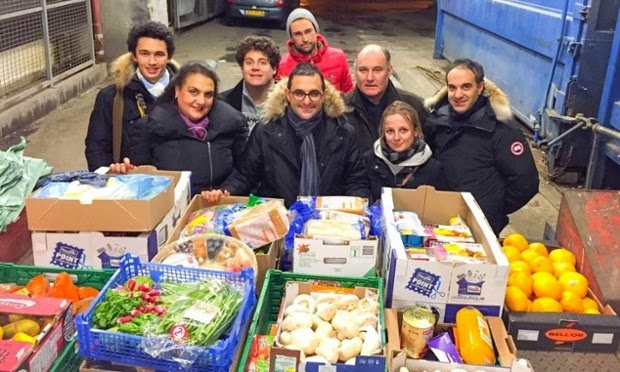
Man who forced French supermarkets to donate food wants to take law global

Arash Derambarsh, a local councillor who kickstarted fight against food waste in his Paris suburb, wants to convince more countries to follow France’s example

The Guardian, Kim Willsher in Paris, Monday 25 May 2015

People shop in a supermarket in southern France. Photograph: Rremy
Gabalda/AFP/Getty Images

A councillor whose campaign against food waste led to a law forcing French supermarkets to donate unwanted food to charity has set his sights on getting similar legislation passed globally.

Arash Derambarsh.
Photograph:
Bertrand Guay/AFP
Arash Derambarsh said it was “scandalous and absurd” that food is wasted and in some cases deliberately spoiled while the homeless, poor and unemployed go hungry.

Derambarsh – a municipal councillor for the “Divers Droit” (diverse right) in Courbevoie, north-west of Paris – persuaded French MPs to adopt the regulation after a petition gained more than 200,000 signatures and celebrity support in just four months.

The amendment was approved as part of a wider law – the Loi Macron – that covers economic activity and equality in France and is expected to be passed by the national assembly on Tuesday, entering the statute books shortly afterwards.

It will bar supermarkets from throwing away food approaching best-before dates and deliberately poisoning products with bleach to stop them being retrieved by people foraging through bins.

Now Derambarsh wants to convince European countries and the wider world to adopt similar bans. “Food is the basis of life, it is an elementary factor in our existence,” he told the Guardian.

Arash Derambarsh began his drive to fight food waste and food
Poverty in Courbevoie. Photograph: Bertrand Guay/AFP

“I have been insulted and attacked and accused of being naive and idealistic, but I became a local councillor because I wanted to help people. Perhaps it is naive to be concerned about other human beings, but I know what it is like to be hungry.

“When I was a law student living on about €400 a month after I’d paid my rent, I used to have one proper meal a day around 5pm. I’d eat pasta, or potatoes, but it’s hard to study or work if you are hungry and always thinking about where the next meal will come from.”

Derambarsh started his campaign by collecting and distributing unwanted food from his local supermarket. “Every day we’d help around 100 people. Half would be single mothers with several children, pensioners or public workers on low salaries, the other half would be those living on the streets or in shelters,” he said.

Derambarsh is planning to table the issue – via the campaign group ONE, founded by U2 singer Bono – when the United Nations discusses its Millennium development goals to end poverty in September as well as at the G20 economic summit in Turkey in November and the COP21 environment conference in Paris in December.

An estimated 7.1m tonnes of food is binned in France each year – 67% of it by consumers, 15% by restaurants and 11% by shops. The figure for food waste across the EU is 89mtonnes while an estimated 1.3bn tonnes are wasted worldwide.

Sunday, March 15, 2015

UK's first 'poo bus' goes into regular service

Bio-Bus fuelled by human and household waste, which first ran between Bristol and Bath, will operate 15-mile route four days a week

The Guardian, Press Association, Sunday 15 March 2015

Bristol’s Bio Bus runs on faeces and household waste. Photograph: Ben Birchall/PA

Britain’s first “poo bus”, which runs on human and household waste, goes into regular service later this month.

Powered by biomethane gas, the Bio-Bus will use waste from more than 32,000 households along its 15-mile route.

Operated by First West of England, the bus will fill up at a site in Avonmouth, Bristol, where sewage and inedible food waste is turned into biomethane gas.

The bus, which can seat up to 40 people, was unveiled last autumn. First is showing the bus in Bristol on Tuesday before it starts operating four days a week from 25 March.

If the route is successful, First will consider introducing more “poo buses”. The managing director, James Freeman, said: “Since its original unveiling last year, the Bio-Bus has generated worldwide attention and so it’s our great privilege to bring it to the city.

“The Bio-Bus previously made an appearance running between Bath and Bristol airport at the end of last year, but it’s only actually been used once before in the centre of Bristol itself.

“The very fact that it’s running in the city should help to open up a serious debate about how buses are best fuelled, and what is good for the environment.”

Related Articles:


Sunday, January 11, 2015

LG among companies and institutes fined for dumping wastewater

Want China Times, Staff Reporter 2015-01-11

A wastewater treatment facility at a village in Guangzhou, Jan. 8. (File photo/Xinhua)

South Korean multinational conglomerate LG Electronics has been one of the companies heavily fined for dumping wastewater in Guangzhou, Guangdong province last year, reports local newspaper Information Times.

The Guangzhou Environmental Bureau published a list of companies fined and punished for the excessive dumping of wastewater last year on Friday. LG was fined 86,432 yuan (US$13,900) in the fourth quarter. It was not the first time the South Korean company was fined for pollution. In October last year, residents near the city's science development zone complained of strong odors from LG's factories. The bureau said the company received more than 23 complaints between June and October last year. The company has made six attempts to improve its facilities, such as the creation of sewage treatment facilities, since then.

The bureau also fined Guangzhou Paper Group 100,000 yuan (US$16,100) for failing to have its automatic pollutant monitoring devices verified. Lianzhou Guangzhou Stainless Steel was fined twice for dumping wastewater exceeding safety levels.

Of the medical institutions fined, Guangzhou Women and Children's Medical Center was fined 17,458 yuan (US$2,800) in the first quarter last year. It is one of the five hospitals that received a penalty for dumping wastewater during the period. The bureau fined another five local hospitals for the same reason in the second quarter. Guangzhou Da'an Clinical Examination Center Limited was the only company fined for dumping polluted wastewater in the third quarter.

Thursday, January 8, 2015

Bill Gates drinks cup of water that used to be human poop (VIDEO)

RT.com, January 07, 2015

Screenshot from YouTube user thegatesnotes

Billionaire activist Bill Gates is backing an innovation in water filtration that turns human poop into drinking water. The OmniProcessor could bring clean water to millions of people and help solve the problem of debilitating diseases.

The OmniProcessor, designed and built by Seattle engineering firm Janicki Bioenergy, burns human waste to produce electricity and water. The processor powers itself through the use of a steam engine and does not emit an odor. The machine could handle 14 tons of waste from 100,000 people, producing up to 86,000 liters of drinkable water a day, and net 250 kw of electricity.

At a demonstration of the OmniProcessor shown on GatesNotes, a smiling Bill Gates drank water from the machine, which was previously untreated sewage.


“It’s water,” said Gates in the video.

He wrote on his blog: "The water tasted as good as any I’ve had out of a bottle. And having studied the engineering behind it, I would happily drink it every day. It’s that safe."

Gates said that 2.5 billion people – or 40 percent of the global population – have no access to safe sanitation, and many people use facilities that do not safely dispose of human waste. About 1.5 million children die every year from contaminated food and water, and half of all patients in hospitals are there because of problems with water and sanitation. It is extremely costly to try and create sewage infrastructure in cities and towns that already exist, so Gates thinks the low cost water treatment machine could be revolutionary.

Screenshot from YouTube user thegatesnotes

“If you can get thousands of these things out there, then you’ve ensured the people really will grow up in a healthy way,” Gates told Wired. “They’ll live much higher quality lives. You will save a lot of lives. And you’ll have local entrepreneurs who are maintaining these things.”

The OmniProcessor, which costs $1.5 million, will undergo a pilot launch in Dakar, Senegal later this year.

Related Articles:


Rural India's low-cost sanitary pad revolution


"2013 - What Now ?" – Jan 6, 2013 (Kryon Channelling by Lee Caroll) (Text version)

“… New ideas are things you never thought of. These ideas will be given to you so you will have answers to the most profound questions that your societies have had since you were born. Inventions will bring clean water to every Human on the planet, cheaply and everywhere. Inventions will give you power, cheaply and everywhere. These ideas will wipe out all of the reasons you now have for pollution, and when you look back on it, you'll go, "This solution was always there. Why didn't we think of that? Why didn't we do this sooner?" Because it wasn't time and you were not ready. You hadn't planted the seeds and you were still battling the old energy, deciding whether you were going to terminate yourselves before 2012. Now you didn't…. and now you didn't.

It's funny, what you ponder about, and what your sociologists consider the "great current problems of mankind", for your new ideas will simply eliminate the very concepts of the questions just as they did in the past. Do you remember? Two hundred years ago, the predictions of sociologists said that you would run out of food, since there wasn't enough land to sustain a greater population. Then you discovered crop rotation and fertilizer. Suddenly, each plot of land could produce many times what it could before. Do you remember the predictions that you would run out of wood to heat your homes? Probably not. That was before electricity. It goes on and on.

So today's puzzles are just as quaint, as you will see. (1)How do you strengthen the power grids of your great nations so that they are not vulnerable to failure or don't require massive infrastructure improvement expenditures? Because cold is coming, and you are going to need more power. (2) What can you do about pollution? (3) What about world overpopulation? Some experts will tell you that a pandemic will be the answer; nature [Gaia] will kill off about one-third of the earth's population. The best minds of the century ponder these puzzles and tell you that you are headed for real problems. You have heard these things all your life.

Let me ask you this. (1) What if you could eliminate the power grid altogether? You can and will. (2) What if pollution-creating sources simply go away, due to new ideas and invention, and the environment starts to self-correct? (3) Overpopulation? You assume that humanity will continue to have children at an exponential rate since they are stupid and can't help themselves. This, dear ones, is a consciousness and education issue, and that is going to change. Imagine a zero growth attribute of many countries - something that will be common. Did you notice that some of your children today are actually starting to ponder if they should have any children at all? What a concept! ….”

Thursday, January 1, 2015

Antibiotic makers polluting China's drinking water: CCTV

Want China Times, Staff Reporter 2015-01-01

A pharmacist in Meishan, Sichuan province. (File photo/Xinhua)

Antibiotics producers in China are suspected of dumping waste water and polluting the country's drinking water sources, reports national broadcaster China Central Television (CCTV).

Following an investigation into pollution emitted from antibiotics producers around the country, CCTV came out with the results of samples taken from drinking water, drains and water sources near factories and livestock farms. Even water in the vicinity of the Jining factory of Shandong Lukang Pharmaceutical, previously considered a leader in pollution prevention facilities, was found containing the highest levels of antibiotics in the study. The Ministry of Environmental Protection has sent a team to the city for further investigation.

Other water samples, especially those taking from water near major antibiotic factories, tested positive for antibiotics.

The company is one of four major antibiotic producers in China. Its 2013 financial report shows 222 million yuan (US$35 million) of its 1.44 billion yuan (US$231 million) revenue came from active ingredients while another 227 million yuan (US$36 million) came from semi-synthetic active ingredients and 970 million (US$155 million) from medicines.

According to the China Chamber of Commerce of Medicine & Health Products Importers and Exporters, China produced 121,200 tons of antibiotics in 2013 and exported 34,300 tons, or US$2.19 billion in value. The active ingredients produced in the country amounted to 70% of the global market.

Active ingredients are costly and energy intensive to manufacture. Developed countries have been focusing on producing high-end antibiotic products and have relocated the production of active ingredients to other countries. The active ingredients of multinational pharmaceutical companies are typically manufactured in emerging countries. Around 180 million yuan (US$28 million) of Shandong Lukang Pharmaceutical's revenue in 2013 came from other countries.

Cai Dongchen, chairman of CSPC Pharmaceutical Group, said active ingredient manufacturing is inefficient and water treatment is costly. China also lacks the technologies and equipment for cleaning the materials during the production process, said the chairman.

Sources familiar with Shandong Lukang Pharmaceutical said Chinese antibiotic producers will, like their European counterparts, be forced to relocate production sites if national environmental protection standards are stringently enforced.

Stuck in the upstream production process leaves the industry will little room for profit on manufacturing low-end active ingredients. Tighter government controls on the use of antibiotics are further squeezing industry margins. Antibiotic uses in hospitals have dropped from 68% in 2010 to 53.5% in 2013, according to the report.

Some antibiotic producers are redirecting funds set aside for saving energy and reducing carbon emissions to improving their production in order to compete on the market, said an industry insider.

Saturday, August 30, 2014

Food banks in Taiwan launch alliance to share resources

Want China Times, CNA 2014-08-30

Food provided by 1919 Food Bank. (Photo/Kuo Chia-jung)

Six food banks in Taiwan launched an alliance in Taipei Thursday to share their resources and logistics more effectively and to push for legislation that encourages donations to food banks.

The founding of the Cozy Food Bank Alliance in Taiwan is aimed at "saying no to wasting resources," the alliance said in a statement.

Its members include the Taiwan People's Food Bank Association, the 1919 Food Bank, the Andrew Food Bank, the Chinese Youth Peace Corps Food Bank, the Southern Airport's Jen Ji Shiang Food Bank and the Red Cross Society of the Republic of China's Taichung branch, which operates a food bank in the central municipality.

"We hope to send the supplies to people in need in the fastest and most efficient way," Lawrence Liu, president of the Taiwan People's Food Bank Association and the first secretary-general of the alliance, said at a press conference.

Members of the alliance will share resources, information and logistics with each other, and cooperate in disaster relief assistance, community development and care services, Liu said.

They will also push for legislation that gives tax breaks to individuals and companies that donate to food banks, allows food banks or the public to purchase excess farm produce at discounted prices to give to the needy, and better ensure the safety of the food being distributed, Liu said.

He said Taiwan wastes 2.75 million tons of food each year, enough to feed 260,000 low-income households for 20 years.

Anthony Kitchen, manager of network programs with the US-based Global FoodBanking Network, stressed that food banks create a "win-win" situation for all involved.

In addition to helping people in need, food banks benefit businesses and organizations that have a problem with surplus food, which could otherwise cost time and money to deal with, he said at the press conference.

A food bank collects and distributes surplus food to people too impoverished to adequately feed themselves and their families. The first food bank was established in the United States in 1967.

The Taiwan People's Food Bank Association became the 24th member of the Global FoodBanking Network in 2012.

Related Article:


First 'boycott tomatoes' arrive at Dutch food banks

DutchNews.nl, Wednesday 27 August 2014

(NOS)
A consignment of 4,000 kilos of tomatoes have been delivered to Arnhem’s food banks under new rules to stop food waste because of the Russian boycott of Dutch produce.

The economic affairs ministry has brought in temporary rules to allow growers to remove fruit and vegetables destined for Russia from the market.

Brussels has set aside €125m to compensate growers for the loss of trade and the compensation is higher if the produce is sent to food banks, news agency ANP said.

The compensation deal applies to tomatoes, carrots, white cabbage, bell peppers, cauliflower, cucumbers, mushrooms, apples, pears and various soft fruits.

The Dutch food bank association estimates it can distribute 300,000 kilos of fruit and veg a week to low income families.

So far 45 growers have come forward to claim compensation, the Financieele Dagblad said.

Sunday, June 15, 2014

Indonesia's poor swap garbage for health care

Yahoo – AFP, Maud Watine, 15 June 2014

Doctor Gamal Albinsaid (L) attends to a patient at Klinik Bumi Ayu in Malang,
on Indonesia's main island of Java, on April 26, 2014 (AFP Photo/Aman Rochman)

Mahmud hauls bags full of rubbish to the small, dilapidated clinic next to a busy road on Indonesia's main island of Java several times a month.

There he exchanges grubby cardboard boxes, plastic bottles and other garbage for something he would struggle to afford otherwise -- medical treatment.

"I know I can sell my garbage here so I keep it," said the 60-year-old, who like many Indonesians goes by one name. "I used to throw everything onto the street but I have started telling myself that actually the garbage is useful."

A nurse at Klinik Bumi Ayu in Malang, on
 Indonesia's main island of Java, collects
packs of recyclable garbage delivered by
members of the clinic, on April 26, 2014
(AFP Photo/Aman Rochman)
Mahmud, who suffers from arthritis, is one of many members of the Klinik Bumi Ayu in Malang who regularly bring in rubbish in exchange for check-ups and medicine.

There are five such centres in the city that are part of a scheme dubbed "Garbage Clinical Insurance" by its 24-year-old founder Gamal Albinsaid, offering treatment and advice for free to some of the country's poorest.

As Southeast Asia's biggest economy struggles to spread the riches earned in recent years to the poorest in society, the clinics are a creative attempt to fill the gaps left by a threadbare welfare system.

The government this year began rolling out what is supposed to be a universal healthcare system across the sprawling archipelago of 250 million people.

Once fully implemented by 2019, it is expected to cost around $15 billion a year -- but critics say it is underfunded and Indonesia lacks enough well-trained medical staff.

In a country where half the population lives on $2 a day, spreading the gains from a sustained economic boom has been in sharp focus recently, with contenders running in July presidential elections pledging to better the lot of society's underprivileged.

Beyond healthcare, Albinsaid's initiative has had another notable benefit -- it has created an army of cleaners to clear the streets in and around Malang, which like many cities in fast-growing Indonesia struggles to keep litter from piling up.

Albinsaid decided to open a first centre in 2010 after hearing the story of a young daughter of a rubbish collector who died after contracting diarrhoea. Her family could not afford treatment.

That clinic failed to get off the ground, but in 2013, Albinsaid and four others got together the funding to open five centres in Malang, and they have so far been doing well.

His achievements were recognised in January when he was awarded the Unilever Young Sustainability Entrepreneur Prize by Britain's Prince Charles at a ceremony in London, which included 50,000 euros ($70,000) in financial support and mentoring.

Trash for treatment

A member of Klinik Bumi Ayu is seen
 holding her child while also carrying a
bag of recyclable garbage, at the clinic
in Malang, on Indonesia's main island of
Java, on April 26, 2014 (AFP Photo/
Aman Rochman)
People who want treatment at the clinics bring in rubbish once a week on Saturdays. They must collect 10,000 rupiah (90 US cents) worth of garbage every month to be a member of the scheme, and this qualifies them for two visits a month.

Different types of rubbish are worth different amounts, according to Albinsaid. Organic waste can be turned in to fertiliser which is sold to farmers, and other materials, such as plastic and metal, are bought by rubbish collectors who process it and sell it on.

The Klinik Bumi Ayu is staffed by two doctors, one nurse and two pharmacists and is open daily in the afternoons. Most of the patients are agricultural workers who toil in the rice paddies surrounding Malang, in eastern Java.

On a recent Saturday at the centre, about 10 patients were waiting to be seen by doctors.

A woman held her two-year-old daughter close, wrapped in a sarong, the young girl's eyes puffed up and red. After a quick examination, a doctor diagnosed her with a severe bout of diarrhoea and sent her away with some medicine.

Efriko Septananda, a doctor at the clinic, said common problems people came in with include high blood pressure, diabetes, runny noses and gastroenteritis.

Most earn between 500,000 and one million rupiah a month ($44-88), and would struggle to get good medical treatment if the clinic did not provide it in exchange for rubbish, he said.

'Now I can pray normally'

Free public healthcare does exist in Malang and other parts of Indonesia. But getting access to it is a complicated, highly bureaucratic process, according to Albinsaid.

For Mahmud, treatment at the centre has helped ease his arthritis.

Nurses of Klinik Bumi Ayu collect recyclable
 garbage from vendors in public market who
are also members of the clinic, in Malang,
on Indonesia's main island of Java, on
April 26, 2014 (AFP Photo/Aman Rochman)
"Before I did not feel well, especially when I had to bend over to pray," he said. "But now I can pray normally."

More than 90 percent of Indonesia's population describe themselves as Muslim.

Albinsaid, who is training to be a doctor but does not treat patients at the clinics himself, said the system has been successful as only 10 to 15 percent of people who bring in garbage use the services.

This leaves enough money to run the centre and fund its development.

He hopes to expand the scheme across Indonesia with clinics planned in three other cities so far, and the government has also taken an interest in getting involved.

For Albinsaid, it is also about giving some of the least privileged in the country greater control of their destinies.

"With these clinics, we can help empower poor people," he said.