Yahoo – AFP, Issam Ahmed, Lucie Aubourg and Paul Handley, May 30, 2021
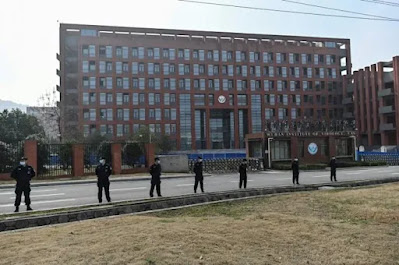 |
This general view shows the Wuhan Institute of Virplogy in Wuhan,
in China's central Hubei province |
The theory that Covid-19 might be the result of
scientific experiments has thrown a spotlight on the work of the world's most
secure biolabs.
While the evidence linking SARS-CoV-2 to the Wuhan
Institute of Virology in China is strictly circumstantial, a number of experts
want tougher controls on such facilities over fears that accidental leaks could
touch off the next pandemic.
Here's what you should know.
59 top facilities
The Wuhan lab belongs to the most secure class, commonly
referred to as biosafety level 4, or BSL4.
These are built to work safely and securely with the
most dangerous bacteria and viruses that can cause serious diseases for which
there are no known treatment or vaccines.
"There are HVAC filtration systems, so that the
virus can't escape through exhaust; any waste water that leaves the facility is
treated with either chemicals or high temperatures to make sure that there's
nothing alive," Gregory Koblentz, director of the Biodefense Graduate
Program at George Mason University, told AFP.
The researchers themselves are highly trained and wear
hazmat suits.
There are 59 such facilities across the world,
according to a report Koblentz co-authored that was released this week.
"There are no binding international standards for
safe, secure, and responsible work on pathogens," the report, called
Mapping Maximum Biological Containment Labs Globally, said.
Accidents do happen
Accidents can happen, sometimes at the top tier facilities,
and much more frequently at lower rung labs of which there are thousands.
Human H1N1 virus -- the same flu that caused the 1918
pandemic -- leaked in 1977 in the Soviet Union and China and spread worldwide.
In 2001, a mentally disturbed employee at a US biolab
mailed out anthrax spores across the country, killing five people.
Two Chinese researchers exposed to SARS in 2004 spread
the disease to others, killing one.
In 2014, a handful of smallpox vials were uncovered
during an Food and Drug Administration office move.
Lynn Klotz, a senior science fellow at the Center for
Arms Control and Non-Proliferation, has been sounding the alarm for many years
about the public safety threats posed by such facilities.
"Human errors constitute over 70 percent of the
errors in laboratories," he told AFP, adding that US researchers have to
rely on data from Freedom of Information requests to learn of these incidents.
'Gain of function' controversy
There is disagreement between the US government, which
funded bat coronavirus research in Wuhan, and some independent scientists,
about whether this work was controversial "gain of function" (GOF)
research.
GOF research entails modifying pathogens to make them
more transmissible, deadlier, or better able to evade treatment and vaccines --
all to learn how to fight them better.
This field has long been contentious. Debate reached a
fever pitch when two research teams in 2011 showed they could make bird flu
transmissible between mammals.
Harvard epidemiologist Marc Lipsitch told AFP he was
concerned "that it would create a strain of virus that if it infected a
laboratory worker could not just kill that laboratory worker... but also cause
a pandemic."
"The research is not required and does not
contribute to the development of drugs or vaccines," added molecular
biologist Richard Ebright of Rutgers University, one of the staunchest
opponents of this kind of research.
In 2014 the US government announced a pause in federal
funding for such work, which gave way in 2017 to a framework that would
consider each application on a case-by-case basis.
But the process has been criticized as lacking
transparency and credibility.
As late as last year, a nonprofit received funding
from the US on research to "predict spillover potential" of bat
coronavirus to humans in Wuhan.
Questioned by Congress this week, Francis Collins and
Anthony Fauci of the National Institutes of Health denied this amounted to gain
of function research, but Ebright said it clearly does.
The path ahead
None of this means that Covid-19 definitely leaked
from a lab -- in fact there is no hard scientific evidence in favor of natural
origin or lab accident scenario, said Ebright.
But there are certain lines of circumstantial evidence
in favor of the latter. For instance, Wuhan is around 1,000 miles north of bat
caves that harbor the ancestor virus, well out of the animals' flight range.
Scientists from Wuhan were however known to be
carrying out routine trips to those caves to take samples.
Alina Chan, a molecular biologist from the Broad
Institute, said there were no signs of risky pathogen research dying down in
the wake of the pandemic -- in fact "it's possibly expanded."
Last year, Chan published research showing that,
unlike SARS, SARS-CoV-2 was not evolving fast when it was first detected in
humans -- another piece of circumstantial evidence that could point to lab
origin.
Chan considers herself a "fence-sitter" on
the competing hypotheses, but does not favor banning risky research, fearing it
would then go underground.
One solution "might just be as simple as moving
these research institutes out into extremely remote areas...where you have to
quarantine for two weeks before we re-enter in human society," she said.
Related Articles:
Chinese citizen journalist jailed for Wuhan virus reporting
US sees new pressure point as coronavirus hits Iran
(>13.46 Min - Reference to the Global Coronavirus crisis)


